Sejong the Great
A Joseon king, a new script and the work of a scholarly court.
Public life
On this page
Life overview
Sejong ruled Joseon from 1418 to 1450. These five stages follow his life in the capital and distinguish the creation of Hunminjeongeum from its later promulgation. Several stages share one city because this is a history of court work, not an invented journey.
Places and turning points
Dashed lines show the order of selected places, not an exact travel route.
1397
Born into the Joseon royal family
Hanyang, now Seoul City-level representative point
Yi Do, later known as Sejong, was born in Hanyang as the third son of the future King Taejong and Queen Wongyeong. His birthplace lay in the capital, rather than at the later royal tomb in Yeoju. This opening point marks his family origins before his unexpected path to succession.
City-level representative point; it does not locate a particular room, institution or travel route.
Representative coordinates · 37.5665°, 126.978°
1418
Accession at Gyeongbokgung
Hanyang, now Seoul City-level representative point
After replacing his elder brother as crown prince, Sejong received the throne from Taejong and became Joseon’s fourth king. The accession took place at Gyeongbokgung Palace. Taejong retained influence, especially over military affairs, so the change of monarch did not immediately transfer every part of political power to the new ruler.
City-level representative point; it does not locate a particular room, institution or travel route.
Representative coordinates · 37.5665°, 126.978°
1443, twelfth lunar month
Twenty-eight new letters are recorded
Hanyang, now Seoul City-level representative point
The Veritable Records of King Sejong first report his creation of twenty-eight letters in the twelfth lunar month of 1443. The new system was intended to make Korean speech easier to write. This is the annals’ calendar year, not a claim that the record falls in Gregorian December; explanation and publication followed.
City-level representative point; it does not locate a particular room, institution or travel route.
Representative coordinates · 37.5665°, 126.978°
1446, ninth lunar month
Hunminjeongeum is promulgated
Hanyang, now Seoul City-level representative point
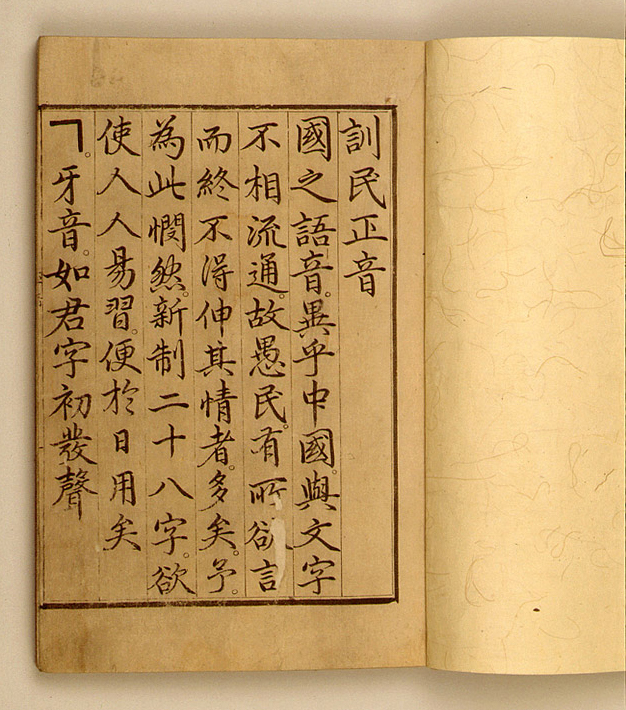
Hunminjeongeum was promulgated with explanations of how the letters worked. The Haerye edition combines the king’s account of the system with scholarly explanations and Jeong Inji’s postface. It makes the design’s principles available as a document; publication should not be mistaken for immediate universal literacy or the disappearance of Literary Chinese.
City-level representative point; it does not locate a particular room, institution or travel route.
Representative coordinates · 37.5665°, 126.978°
1450
Death and a continuing written legacy
Hanyang, now Seoul City-level representative point
Sejong died after moving to the residence of his son, Prince Yeongeung. His heir succeeded him as King Munjong. The capital point marks the end of his life, not his present tomb: his burial was relocated to Yeoju in 1469. The script and books outlasted the ruler who had sponsored them.
City-level representative point; it does not locate a particular room, institution or travel route.
Representative coordinates · 37.5665°, 126.978°
Legacy and context
His court supported language, astronomy, music and publishing. Hunminjeongeum provided a new way to write Korean alongside the existing use of Literary Chinese. Its development involved royal direction and scholarly explanation; the original twenty-eight letters should not be confused with the modern basic alphabet.
Bibliography
- Sejong Center: The Story of King Sejong
- National Hangeul Museum: Hunminjeongeum and Hangeul
- UNESCO: Hunminjeongum Manuscript
- National Institute of Korean History: Sejong
References support specific dates and context. Bibliographies are displayed as text.
Image and source
Preface page of Hunminjeongeum Haerye, 1446
A reproduced page of the 1446 Hunminjeongeum Haerye showing Sejong’s preface in Literary Chinese. It is a historical document, not a portrait or a scene of the alphabet’s creation. The reproduction’s photographer and date are not identified.
- Creator
- Sejong (preface); reproduction photographer not identified
- Collection / image provider
- Kansong Art Museum (historical document) · Wikimedia Commons
- Source and reuse
- Source record · Public domain
The source identifies this image as public domain. Consult its item-specific rights record and terms below; CivAtlas does not claim new copyright or grant additional rights in this image.
Public domain, as identified in the source record. Source credit: Sejong (preface); reproduction photographer not identified. Reuse terms: Public domain.