
c. 1455 CE / Europe
Gutenberg and the Spread of Printing in Europe
The combination of metal movable type, ink, and press technology gradually expanded the scale of book reproduction in Europe and changed the conditions for spreading knowledge.
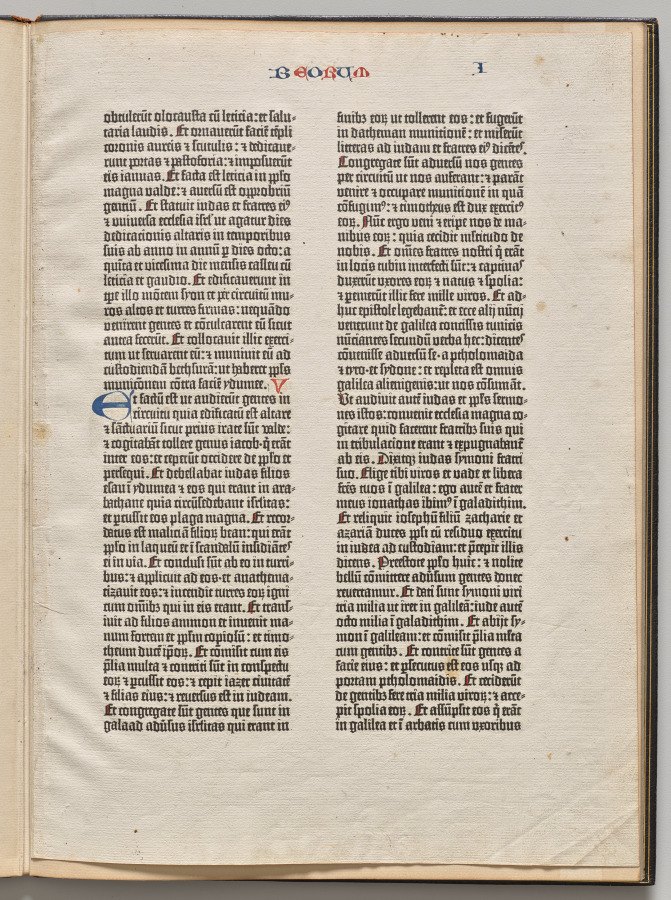
Image unavailable. The caption and source are still available.
The story
In the mid-fifteenth century, Gutenberg and his collaborators printed a Latin Bible in Mainz, demonstrating a combination of technologies suited to reproducing books in large numbers. Printing workshops subsequently spread across Europe, influencing religious disputes, education, and scholarly exchange, although literacy and access to books remained highly unequal. Printing did not first appear here: East Asian traditions of woodblock and movable-type printing were earlier, and European developments should be understood within the technological history of multiple regions.
Elsewhere in the world
When European movable-type printing emerged, East Asia already had long traditions of woodblock and movable-type printing; Korean metal movable type also predated Gutenberg.
Dates and precision
c. 1455 CE Approximate year
An archaeological or scholarly estimate, rather than a claim that an event occurred in one exact year.
Representative map location
Representative coordinates · 49.999°, 8.273°
Coordinates locate a representative point for the story. They do not mean the event happened only here and do not represent historical borders.
Bibliography
- Library of Congress | The Gutenberg Bible
- UNESCO | Jikji: The 1377 Metal Movable-Type Edition
Sources are listed as bibliography titles, without external links. A reference does not mean every sentence or interpretation has been independently verified.