Qin Shi Huang
From a prince in Zhao to the first Qin emperor
Public life
On this page
Life overview
Born Ying Zheng in Handan, the future Qin Shi Huang inherited the Qin throne and completed the conquest of the six rival states in 221 BCE. His itinerary links a contested interstate world, the capital at Xianyang and the public rituals of the new empire.
Places and turning points
Dashed lines show the order of selected places, not an exact travel route.
259 BCE
Birth in the state of Zhao
Handan, capital of Zhao City-level representative point
Ying Zheng was born in Handan while his father, the future King Zhuangxiang of Qin, was living in Zhao as a royal hostage. His birthplace reflects the diplomatic exchanges and tensions of the Warring States period. Later stories about his parentage are not treated here as established evidence.
City-level reference; the marker does not identify a particular room or building.
Representative coordinates · 36.625°, 114.539°
247 BCE; first regnal year 246 BCE
Inheriting the Qin throne
Xianyang, Qin City-level representative point
After King Zhuangxiang died, Zheng inherited the Qin throne. The mausoleum museum dates the succession to 247 BCE and lists 246 BCE as his first regnal year. His youth initially left powerful ministers and the royal household with substantial influence; later personal rule was a separate development.
City-level reference; the marker does not identify a particular room or building.
Representative coordinates · 34.3296°, 108.7088°
221 BCE
Taking the title of emperor
Xianyang City-level representative point
The conquest of Qi completed Qin’s defeat of the six rival states. Zheng adopted the title huangdi and governed from Xianyang through centrally appointed officials and commanderies. Standardization of writing, weights and measures supported administration across the new empire, although implementation was a process rather than a single-day change.
City-level reference; the marker does not identify a particular room or building.
Representative coordinates · 34.3296°, 108.7088°
219 BCE
Rituals and inscriptions at Mount Tai
Mount Tai, near present-day Tai’an City-level representative point
On an eastern tour, the emperor ascended Mount Tai and performed imperial sacrifices. Inscriptions publicly represented the authority and achievements claimed by the new regime. The National Museum’s surviving-rubbing entry preserves this textual history; a later rubbing must be distinguished from the original Qin stone and its changing remains.
City-level reference; the marker does not identify a particular room or building.
Representative coordinates · 36.2003°, 117.0876°
210 BCE
Death during the final tour
Shaqiu, in present-day Guangzong County Representative area
The emperor fell ill during his last tour and died at Shaqiu. His body was subsequently returned for burial at the mausoleum near Mount Li. The map marks the broad Shaqiu region, not a verified death chamber; burial near modern Xi’an is a separate place and later part of the sequence.
Regional reference for ancient Shaqiu; the precise death chamber is not established.
Representative coordinates · 37.075°, 115.143°
Legacy and context
The imperial title and centralized administrative measures associated with his reign influenced later dynasties. Dates before the Common Era are expressed as modern year equivalents; succession in 247 BCE is distinguished from his first regnal year in 246 BCE.
Bibliography
- 秦始皇帝陵博物院:关于秦始皇 (Chinese source)
- 中国文化研究院:秦始皇(张传玺主编、王双怀著) (Chinese source)
- 中国国家博物馆:泰山刻石残字册页 (Chinese source)
References support specific dates and context. Bibliographies are displayed as text.
Image and source
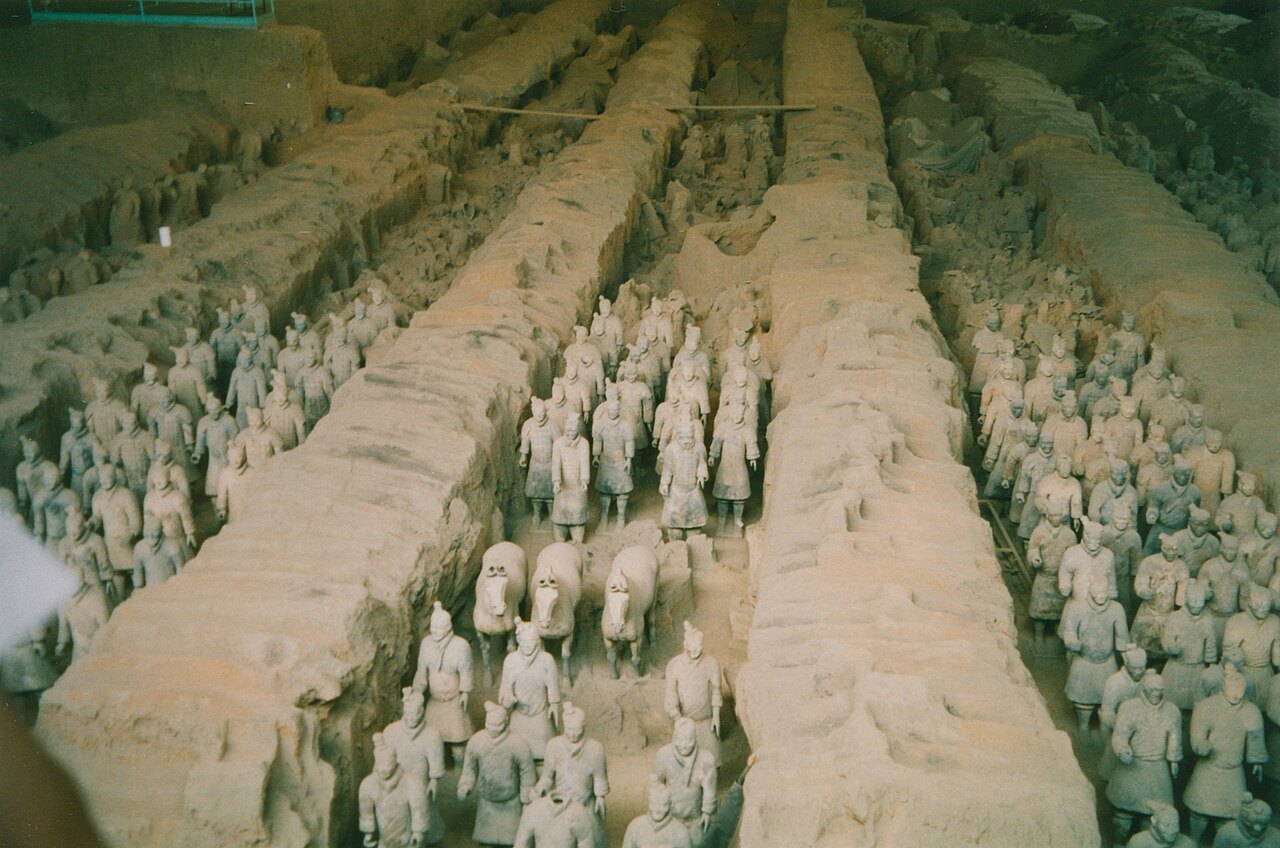
Terracotta warriors of the First Qin Emperor
Photograph taken in 1995 of the terracotta army from the First Qin Emperor’s mausoleum. These funerary figures are archaeological remains of the Qin imperial period, not a view of the conquest of 221 BCE.
- Creator
- Arian Zwegers from Brussels, Belgium
- Collection / image provider
- UNESCO World Heritage Centre · Wikimedia Commons
- Source and reuse
- Source record · CC BY 2.0
Reuse is governed by the original license linked below, including required credits, license links and notices of changes. Follow ShareAlike terms where the license requires them. CivAtlas does not grant additional rights in third-party images. For other uses, consult the rights contact identified by the original source.
Source credit: Arian Zwegers from Brussels, Belgium. Reuse terms: CC BY 2.0. Arian Zwegers from Brussels, Belgium, via Wikimedia Commons. CC BY 2.0 (https://creativecommons.org/licenses/by/2.0). Existing local JPEG was proportionally resized and compressed; this reuse preserves its bytes without further alteration.