Public life / 1918–2013
Nelson Mandela
From the Eastern Cape to imprisonment and democratic government
Life overview
Mandela’s life connects a rural Eastern Cape childhood, legal and political work, long imprisonment and South Africa’s democratic transition. Five stages show those changes within one country. His role was significant within a much wider struggle involving communities, organisations and negotiations.
Places and turning points
Dashed lines show the order of selected places, not an exact travel route.
18 July 1918
A childhood beginning in Mvezo
Mvezo, Eastern Cape Representative area
Rolihlahla Mandela was born in Mvezo in the Eastern Cape. He later lived in other communities and attended several schools, so this marker introduces his childhood region rather than locating every early experience in one village. The name Nelson was given to him at school, alongside the name by which his family knew him.
Regional reference at modern Mvezo; it is not a verified birth-house coordinate or the location of every childhood school.
Representative coordinates · -31.9583°, 28.5117°
1941–1952 · selected early city years
Law and political organising in Johannesburg
Johannesburg City-level representative point
Mandela arrived in Johannesburg in 1941, worked and pursued legal studies. He joined the African National Congress in 1944 and helped organise its Youth League. In 1952 he and Oliver Tambo established a law practice. Legal work and political organising developed together; his city life cannot be reduced to a single address.
City-level Johannesburg reference; it does not identify a particular office, house or university classroom.
Representative coordinates · -26.2041°, 28.0473°
1964–1982
The long imprisonment on Robben Island
Robben Island, near Cape Town Representative area
After the Rivonia Trial, Mandela was sentenced to life imprisonment in June 1964 and held on Robben Island for the long period shown here. Prison involved forced labour, restricted family contact and exchanges with fellow political prisoners. Transfers followed in 1982 and 1988; the island did not contain all of his twenty-seven years in custody.
Island-level representative point, not a cell or quarry coordinate; later prisons are outside this marker.
Representative coordinates · -33.8067°, 18.3662°
11 February 1990
Walking free near Paarl
Victor Verster Prison, near Paarl City-level representative point
Mandela was released from Victor Verster Prison near Paarl on 11 February 1990, after the unbanning of the African National Congress. He then took part in negotiations over South Africa’s political future. Release was a turning point, not the completion of the transition: talks and violence continued before the 1994 election.
Paarl is a city-level orientation point for the nearby prison; this is not Cape Town City Hall or a prison-gate coordinate.
Representative coordinates · -33.7342°, 18.9621°
10 May 1994–1999
Taking office after the democratic election
Pretoria, South Africa City-level representative point
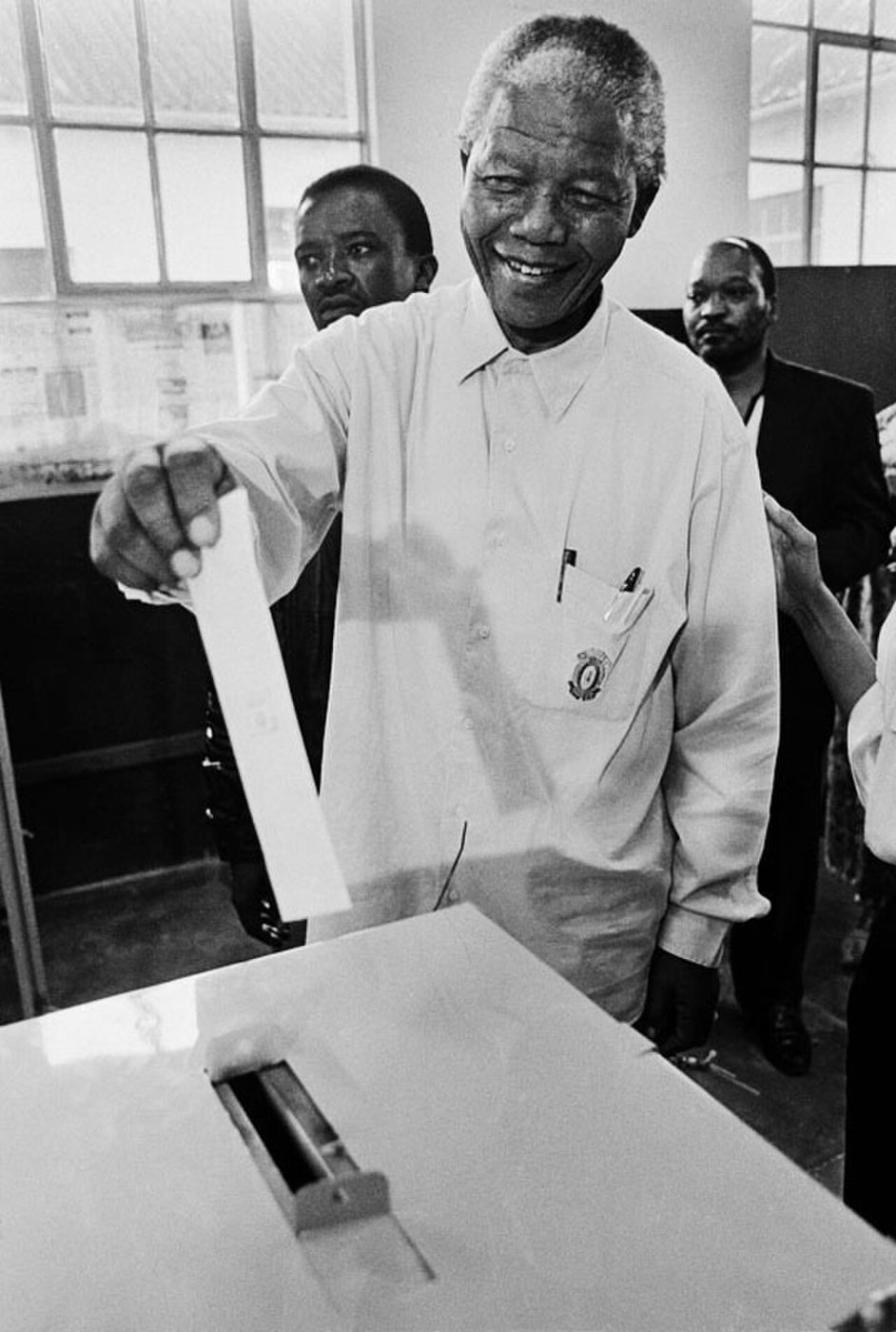
Following the first national democratic election with universal adult suffrage, Mandela was inaugurated at the Union Buildings in Pretoria on 10 May 1994. His presidency sought reconciliation and institutional change, and he left office in 1999. These achievements involved many participants and did not instantly remove poverty or the unequal legacies of apartheid.
City-level Pretoria reference; the documented inauguration was at the Union Buildings, but this marker is not the ceremony’s exact position.
Representative coordinates · -25.7479°, 28.2293°
Legacy and context
The 1994 transition ended white-minority political rule and opened a new constitutional era. It was a collective achievement; inequality and the practical work of reconciliation did not disappear with a presidential inauguration.
Bibliography
- Nelson Mandela Foundation: Biography of Nelson Mandela
- South African Government: Presidential inauguration, 10 May 1994
References support specific dates and context. Bibliographies are displayed as text.
Image and source
Nelson Mandela casts his vote in 1994
Nelson Mandela votes at Ohlange School, Inanda, in April 1994. Paul Weinberg photographed the election on commission for the Independent Electoral Commission.
- Creator
- Paul Weinberg
- Collection / image provider
- Nelson Mandela Foundation, Centre of Memory · Wikimedia Commons
- Source and reuse
- Source record · Creative Commons Attribution ShareAlike 3.0
Reuse is governed by the original license linked below, including required credits, license links and notices of changes. Follow ShareAlike terms where the license requires them. CivAtlas does not grant additional rights in third-party images. For other uses, consult the rights contact identified by the original source.
Source credit: Paul Weinberg. Reuse terms: Creative Commons Attribution ShareAlike 3.0. Photograph by Paul Weinberg, via Wikimedia Commons; CC BY-SA 3.0 (https://creativecommons.org/licenses/by-sa/3.0/). Existing local version proportionally resized and JPEG-compressed; no scene elements added.