Mao Zedong
From Shaoshan to the founding of the PRC
Public life
On this page
Life overview
Mao Zedong was a founder of the Chinese Communist Party and a central political and military leader in the establishment of the People’s Republic of China. These five selected stages connect his Hunan origins, party organization, wartime leadership and later base in Beijing.
Places and turning points
Dashed lines show the order of selected places, not an exact travel route.
26 December 1893
Birth in Shaoshan
Shaoshan, Hunan City-level representative point
Mao was born into a farming household in Shaoshan, then part of Xiangtan County. His early surroundings belonged to rural Hunan rather than the metropolitan centres of later party politics. The marker introduces his home region; it does not reconstruct a precise childhood walking route.
City-level reference; the marker does not identify a particular room or building.
Representative coordinates · 27.915°, 112.528°
July 1921
Attending the first CPC congress
Shanghai City-level representative point
Mao attended the first national congress of the Chinese Communist Party as a delegate from Hunan. The congress opened in Shanghai and concluded after moving to a boat on South Lake in Jiaxing. This stage marks his participation in founding the organization, not the entire congress itinerary.
City-level reference; the marker does not identify a particular room or building.
Representative coordinates · 31.2304°, 121.4737°
January 1935
The Zunyi Conference
Zunyi, Guizhou City-level representative point
During the Long March, an enlarged Politburo meeting in Zunyi reviewed military and organizational decisions. Mao’s position in the leadership strengthened through the conference and subsequent developments. The city marks a turning point within a longer process, rather than an instantaneous transfer of every party and military office.
City-level reference; the marker does not identify a particular room or building.
Representative coordinates · 27.725°, 106.927°
1 October 1949
The establishment of the PRC
Beijing City-level representative point
After the Communist victory in the civil war, the People’s Republic of China was established in Beijing. Mao became chairman of the Central People’s Government and announced the new state at Tiananmen. The event connected his earlier party and military leadership with a new national governmental role.
City-level reference; the marker does not identify a particular room or building.
Representative coordinates · 39.9042°, 116.4074°
9 September 1976
Death in Beijing
Beijing City-level representative point
Mao died in Beijing on 9 September 1976, after serving as chairman of the Chinese Communist Party until the end of his life. His death closed a long period of personal leadership. This endpoint records the documented date and place without presenting the five-stage selection as a complete political biography.
City-level reference; the marker does not identify a particular room or building.
Representative coordinates · 39.9042°, 116.4074°
Legacy and context
His career is closely linked to the transformation of twentieth-century China. This short itinerary identifies selected documented moments rather than providing a comprehensive assessment of his policies or of the period.
Bibliography
- 人民网:中国共产党新闻·毛泽东 (Chinese source)
- 共产党员网:毛泽东同志故居现场教学简介 (Chinese source)
References support specific dates and context. Bibliographies are displayed as text.
Image and source
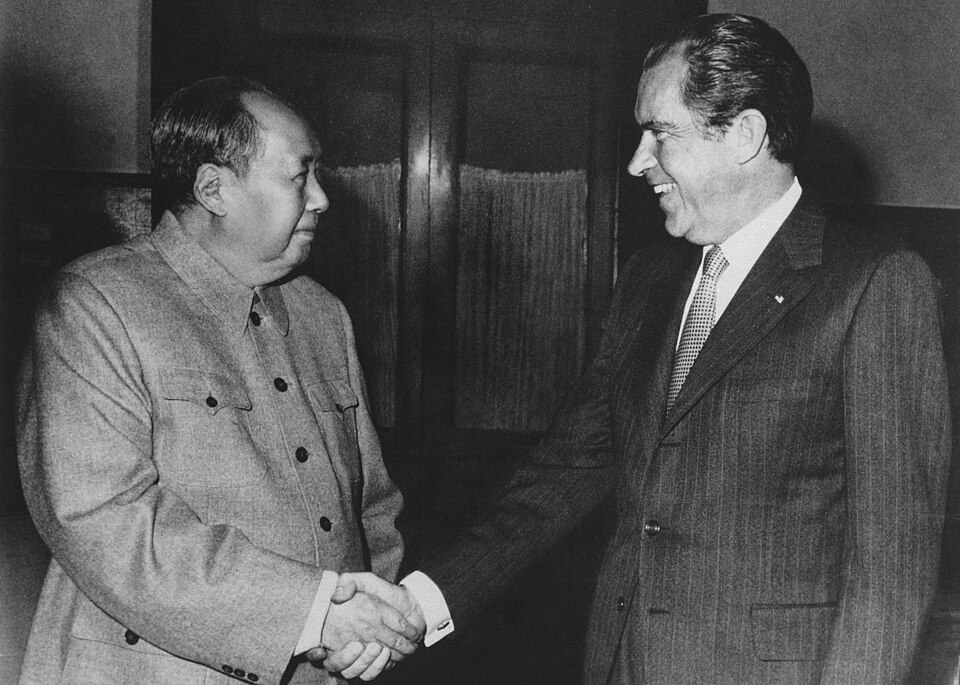
Mao Zedong and Richard Nixon, 1972
Mao Zedong shakes hands with U.S. President Richard Nixon on 21 February 1972. This Nixon White House photographic record depicts that meeting, not an earlier revolutionary event.
- Creator
- Creator not named in the source record
- Collection / image provider
- U.S. National Archives, Nixon White House Photographs · Wikimedia Commons
- Source and reuse
- Source record · Public domain — U.S. federal government work
The source identifies this image as public domain. Consult its item-specific rights record and terms below; CivAtlas does not claim new copyright or grant additional rights in this image.
Public domain, as identified in the source record. Source credit: Creator not named individually in the selected record; Nixon White House Photo Office. Reuse terms: Public domain — U.S. federal government work.