Science and medicine / 1867–1934
Marie Curie
From Warsaw to Paris: research, teaching and medical service.
Life overview
Born Maria Skłodowska in Warsaw, Curie moved to Paris for higher education and made radioactivity the focus of her research. Her selected stages also include wartime medical work and support for the Warsaw Radium Institute, linking laboratory investigation with institutions and care.
Places and turning points
Dashed lines show the order of selected places, not an exact travel route.
7 November 1867
Growing up in Warsaw
Warsaw City-level representative point
Maria Skłodowska was born in Warsaw on 7 November 1867 into a family of teachers. Her early education and later work as a governess preceded her move to France. Warsaw was then under Russian imperial rule; the modern map label does not describe an independent Polish state in 1867.
City-level location; the modern country label is geographic framing, not an 1867 border claim.
Representative coordinates · 52.23°, 21.012°
1891
Arriving to study
Paris City-level representative point
In 1891, Skłodowska came to Paris to study physics and mathematics at the Sorbonne. This was a move for education, before the discoveries for which she became famous. Paris later became the setting of her collaboration with Pierre Curie and of much of her teaching and laboratory work.
City-level location, combining university study and later Paris institutions.
Representative coordinates · 48.8566°, 2.3522°
1898
Evidence for new elements
Paris City-level representative point
In 1898, Marie and Pierre Curie’s investigations led to the identification of polonium and radium. Radioactivity measurements helped reveal substances hidden within mineral samples. Announcing new elements was one stage of a longer experimental process; producing sufficiently purified material required further work and should not be collapsed into that year.
City-level research location; not a map of mineral origins or every laboratory room.
Representative coordinates · 48.8566°, 2.3522°
1914–1918
Organising wartime radiology
Paris and wartime medical services City-level representative point
When war began in 1914, Curie helped organise radiographic equipment and training for medical services. X-ray examinations could help doctors locate injuries and plan treatment. Paris marks an organisational base, while the work extended to hospitals and front-line areas; it was not confined to the city shown here.
Paris is an organisational reference point; this pin does not locate every hospital or front-line visit.
Representative coordinates · 48.8566°, 2.3522°
29 May 1932
Returning for the Radium Institute
Warsaw City-level representative point
Curie attended the official opening of the Warsaw Radium Institute on 29 May 1932. Its creation depended on doctors, researchers, donors and organisers, including her sister Bronisława Dłuska. The institution sought to connect treatment with research; this visit represents support for a collective undertaking, not a permanent return to Warsaw.
Same Warsaw city point as the birth stage; the institute was at Wawelska Street, a different site.
Representative coordinates · 52.23°, 21.012°
Legacy and context
Curie shared the 1903 Nobel Prize in Physics and received the 1911 Chemistry prize. Her career connects experimental measurement, chemical separation and medical applications. The discoveries involved collaboration and prolonged laboratory work; X-ray imaging and treatment using radioactive substances are distinct technologies.
Bibliography
- Nobel Prize: Marie Curie biography
- City of Paris: Marie Curie’s scientific Paris (French)
- Inserm: Marie Curie, radiology and war (French)
- National Institute of Oncology: History of the institute (Polish)
References support specific dates and context. Bibliographies are displayed as text.
Image and source
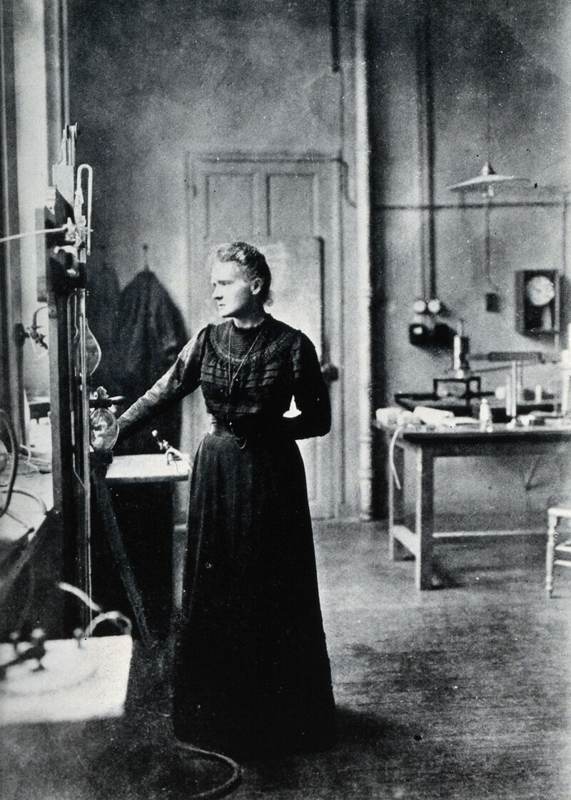
Photographic portrait of Marie Curie
A historical photographic portrait of Marie Curie, used to identify the researcher. It does not show the experiments in which polonium and radium were discovered in 1898.
Date not stated in the record
- Creator
- Creator not named in the source record
- Collection / image provider
- Wellcome Collection
- Source and reuse
- Source record · Public Domain Mark
The source identifies this image as public domain. Consult its item-specific rights record and terms below; CivAtlas does not claim new copyright or grant additional rights in this image.
Public domain, as identified in the source record. Source credit: Creator not named in the official record; supplied by Wellcome Collection. Reuse terms: Public Domain Mark.