Thought and culture / 551–479 BCE · traditional chronology
Confucius
Teaching and government across the states of early China
Life overview
Confucius taught and sought public service during the late Spring and Autumn period. His travels remained within a small part of the territory shown on a modern world map. This itinerary follows traditional dates while distinguishing remembered episodes from precisely located evidence.
Places and turning points
Dashed lines show the order of selected places, not an exact travel route.
From 551 BCE · traditional chronology
Growing up in the state of Lu
Qufu area, state of Lu City-level representative point
Tradition places Confucius’s birth at Zouyi near present-day Qufu. He grew up within Lu’s ritual culture, acquired knowledge of ceremonies and music, and later taught students. His beginnings belong to a landscape of small competing states, rather than the unified territory suggested by a modern national map.
Modern Qufu is a city-level reference point, not an identified birthplace or early classroom.
Representative coordinates · 35.5967°, 116.9911°
Around 501–497 BCE · traditional chronology
Seeking change through public service
Qufu and the state of Lu City-level representative point
Traditional biographies describe Confucius holding offices in Lu, including responsibility associated with justice, before leaving the state. Public service gave practical form to his concern with ritual and good government. The sequence and dating of individual appointments are less secure than a modern official career record.
Qufu represents Lu’s political centre; individual offices and diplomatic meetings are not pinned to buildings.
Representative coordinates · 35.5967°, 116.9911°
From about 497 BCE · traditional chronology
Looking for an audience in Wei
Diqiu, near present-day Puyang City-level representative point
After leaving Lu, Confucius travelled with disciples to Wei, whose capital was Diqiu. Traditional accounts describe support from its ruler but no lasting opportunity to put his programme into government. He returned to Wei more than once; one marker groups these visits rather than inventing a single uninterrupted stay.
Puyang is a modern city-level reference for ancient Diqiu; no specific residence is asserted.
Representative coordinates · 35.7618°, 115.0293°
Around 489 BCE · traditional chronology
Travelling through the Chen–Cai region
Chen–Cai region, represented near Huaiyang Representative area
Accounts of Confucius’s journeys place him in Chen and Cai amid war and political uncertainty. Stories of hunger and discussions with disciples became important to his remembered character. They illuminate a teaching tradition, but do not provide a secure day-by-day itinerary or an undisputed location for every episode.
Regional marker near modern Huaiyang; the exact hardship site and connecting ancient roads remain uncertain.
Representative coordinates · 33.734°, 114.888°
484–479 BCE · traditional chronology
Returning to teaching in Lu
Qufu, state of Lu City-level representative point
Confucius returned to Lu in 484 BCE according to the traditional chronology, and spent his final years teaching and engaging with inherited texts. His death is conventionally dated to 479 BCE. Later disciples and interpreters transmitted his words; the Analects should not be treated as a book he personally wrote.
The same Qufu reference point marks the return; it does not identify a surviving ancient classroom.
Representative coordinates · 35.5967°, 116.9911°
Legacy and context
His teaching, preserved and interpreted by later communities, shaped education, ethics and government across East Asia. Later Confucian institutions were not simply the unchanged programme of one teacher.
Bibliography
- China Confucius Foundation: Confucius (Chinese)
- Meng Jixin: Confucius’s travels (Chinese)
- China Confucius Foundation: Confucianism in Korea (Chinese)
References support specific dates and context. Bibliographies are displayed as text.
Image and source
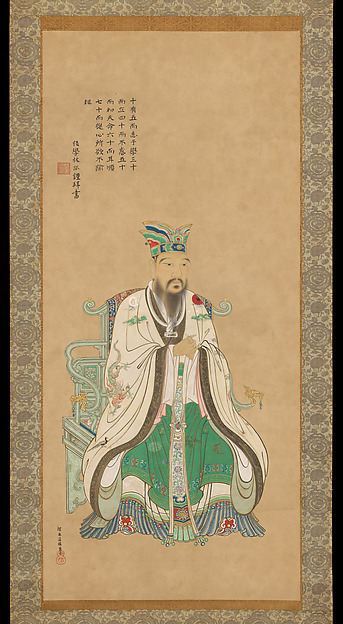
Portrait of Confucius, about 1658
A Japanese painting of Confucius by Kano Tan’yū, with an inscription by Hayashi Gahō, about 1658. This later depiction does not establish Confucius’s appearance during his lifetime.
- Creator
- Kano Tan’yū (painting); Hayashi Gahō (inscription)
- Collection / image provider
- The Metropolitan Museum of Art, New York · The Metropolitan Museum of Art Open Access
- Source and reuse
- Source record · CC0 1.0 Universal
The source makes this image available under CC0 1.0. Consult the dedication and item-specific record below; CivAtlas adds no further restrictions.
CC0 1.0 public-domain dedication, as stated in the source record. Source credit: Kano Tan’yū (painting); Hayashi Gahō (inscription). Reuse terms: CC0 1.0 Universal.