
Science and medicine / 1809–1882
Charles Darwin: Life Timeline and Selected Beagle Stops
Charles Darwin’s life map connects selected places on the Beagle voyage with the research that followed his return to England. It helps separate collecting evidence abroad from the years of comparison, experiments and writing behind On the Origin of Species.
The voyage and the book belong to different periods
Darwin returned to England in 1836; On the Origin of Species appeared in 1859. That gap matters when reading his life. The voyage supplied observations and collections, while later work involved evaluating evidence and developing an explanation. Down House represents this sustained research. The map therefore connects different kinds of work across time, rather than placing a finished theory at a single overseas stop.
An observation and its interpretation need not share a date
Letters and specimens illuminate different parts of the investigation. A letter records what Darwin reported at a particular time, while collected birds still needed identification and comparison; their collection records were not uniformly detailed. Later interpretation should not be read back into every field observation. Comparing these kinds of evidence helps explain why the Galápagos visit matters without turning one encounter with island wildlife into an instant, complete theory.
Life overview
Darwin’s selected stages connect Cambridge, the Beagle voyage and the home where he developed his arguments. The five stops are a reading guide, not a complete itinerary: collecting abroad and evaluating evidence after returning were different parts of his work.
Places and turning points
Dashed lines show the order of selected places, not an exact travel route.
1828–1831
Learning to observe
Cambridge City-level representative point
Darwin entered Christ’s College in January 1828 and pursued a general degree, not a specialist biology qualification. His interest in natural history grew alongside his studies. Cambridge contacts, especially the botanist John Stevens Henslow, later helped connect him with the opportunity to sail on the Beagle.
City-level location for Christ’s College and his Cambridge circle.
Representative coordinates · 52.205°, 0.119°
27 December 1831
The Beagle sets sail
Plymouth City-level representative point
The Beagle departed Plymouth on 27 December 1831 on a surveying voyage. Darwin used the journey for observations and collecting, while sending specimens and letters to colleagues at home. The voyage lasted until October 1836; it was not the date of publication of his evolutionary theory.
Representative port-city location, not a reconstructed anchorage or departure track.
Representative coordinates · 50.376°, -4.143°
September–October 1835
Questions among the islands
Galápagos Islands Representative area
Darwin visited the Galápagos during September and October 1835, collecting animals and comparing island life. The significance of some specimens became clearer only after examination and discussion back in Britain. The familiar finch story should not be read as a complete theory suddenly discovered on one island.
Archipelago-level representative point; several islands and landings are combined here.
Representative coordinates · -0.4°, -90.3°
January 1836
A letter from Sydney
Sydney City-level representative point
Writing to his sister Susan on 28 January 1836, Darwin recorded arriving in Sydney on the 12th and described an excursion inland. His letter places him securely in Australia during the voyage. The gap from the Galápagos includes other stops; the connecting line is not the ship’s actual course.
City-level location; the inland excursion and Pacific stopovers are not individually mapped.
Representative coordinates · -33.869°, 151.209°
1859
From evidence to the Origin
Down House, Downe; publication in London Documented site
Darwin returned to England in 1836 and moved to Down House in 1842, after further journeys not shown here. Long research there helped shape On the Origin of Species, published in London in 1859. This stage separates the voyage, the home research setting and the publication event.
Representative point for Down House and its research grounds, approximately converted from Historic England’s current grid reference TQ 43154 61150. It is not an exact spot inside the study. The 1859 book was published in London.
Representative coordinates · 51.33143°, 0.05344°
Legacy and context
Natural selection and common descent changed how biologists explained living diversity. Darwin’s work drew on specimens, experiments and a wide correspondence network; Alfred Russel Wallace independently developed natural selection. The theory continued to change as later researchers investigated inheritance.
Questions for a closer reading
Is this a complete map of the Beagle’s voyage?
No. The biography selects places that illustrate particular stages, omitting many ports, excursions and passages between them. Connecting lines show the order of those selected stages. They should not be used as a sailing track or a record of every landing.
Does the Down House marker locate the publication of Origin?
It locates a representative place of long-term research and writing, not the publication site. The book was published in London in 1859, after years of research. The house marker does not identify an exact working position within it.
Bibliography
- Christ’s College: Darwin timeline
- Darwin Correspondence Project: The Beagle voyage
- Darwin Online: Itinerary
- Darwin to Susan Darwin, 28 January 1836
- English Heritage: Down House
References support specific dates and context. Bibliographies are displayed as text.
Image and source
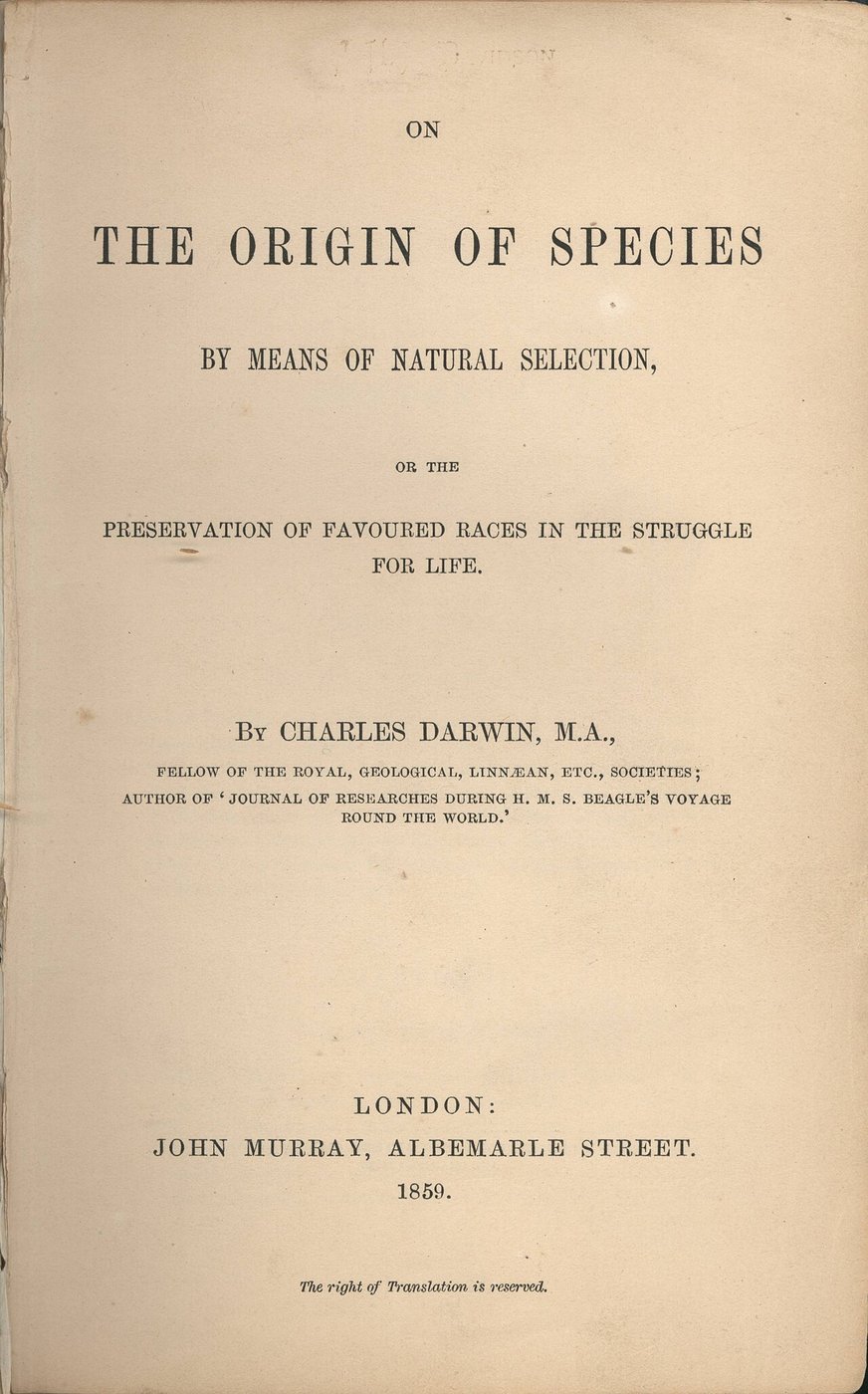
Title page of On the Origin of Species, 1859
The title page of Darwin’s On the Origin of Species, first published by John Murray in 1859. This is a reproduction of a printed historical document.
- Creator
- Charles Darwin; publisher John Murray
- Collection / image provider
- Biodiversity Heritage Library; Harvard University Ernst Mayr Library · Wikimedia Commons
- Source and reuse
- Source record · Public domain
The source identifies this image as public domain. Consult its item-specific rights record and terms below; CivAtlas does not claim new copyright or grant additional rights in this image.
Public domain, as identified in the source record. Source credit: Charles Darwin; publisher John Murray. Reuse terms: Public domain.