
Science and medicine / 1643–1727 (Gregorian; born 1642 in the English calendar then in use)
Isaac Newton: Life Timeline, Cambridge and London
Isaac Newton’s life connects study at Cambridge, return visits to Woolsthorpe and public service in London. These places help explain how his work changed over time; they are reference points, not a reconstruction of every journey.
One place can represent several chapters
A life map becomes clearer when repeated places are read alongside dates. Woolsthorpe represents both Newton’s childhood and later returns during plague closures; Cambridge represents education and subsequent research. His two extended stays at home between 1665 and 1667 should not become an uninterrupted retreat. Following these returns reveals changing work at familiar places, rather than a single journey from birthplace to discovery.
From a college setting to the Royal Mint
Newton’s later move to London adds an institutional chapter to his biography. He became Warden of the Mint in 1696 and took an active part in its work. Read this period alongside his earlier university research to see how his responsibilities changed. A London marker identifies a different working context from Cambridge; it does not locate a particular office or every task he performed.
Life overview
Newton studied at Cambridge, returned to his family home during plague closures, and later worked at the Royal Mint in London. These five selected stages connect the settings of his work without turning a long research career into a single moment of inspiration.
Places and turning points
Dashed lines show the order of selected places, not an exact travel route.
4 January 1643 (Gregorian)
A rural beginning
Woolsthorpe, Lincolnshire Representative area
Newton was born at Woolsthorpe, near Colsterworth. His birthday was recorded as 25 December 1642 under the calendar used in England; in the Gregorian calendar it is 4 January 1643. Keeping both dates prevents two records of the same birth from looking contradictory.
Representative village-area location; not a survey of the room or farmhouse.
Representative coordinates · 52.809°, -0.632°
1661
Entering Trinity
Trinity College, Cambridge Documented site
Newton entered Trinity College in 1661. Cambridge became the main institutional setting of his early mathematical and scientific work. He graduated in 1665 and later returned as a fellow and teacher; the city represents a continuing scholarly home rather than a single classroom.
Representative point for Trinity College’s historic campus buildings, approximately converted from Historic England’s grid reference TL 44696 58629. It does not identify Newton’s room.
Representative coordinates · 52.2069°, 0.11613°
1665–1667, two extended stays
Returning during the plague
Woolsthorpe, Lincolnshire Representative area
During the plague, Newton made two extended stays at Woolsthorpe between summer 1665 and spring 1667. He developed ideas in mathematics, optics and motion while away from Cambridge. These visits were important periods of work, not proof that all his later theories were completed there.
Same representative village area as the birth stage; the intervening journeys are not reconstructed.
Representative coordinates · 52.809°, -0.632°
1687
The Principia reaches print
Trinity College, Cambridge; publication in London Documented site
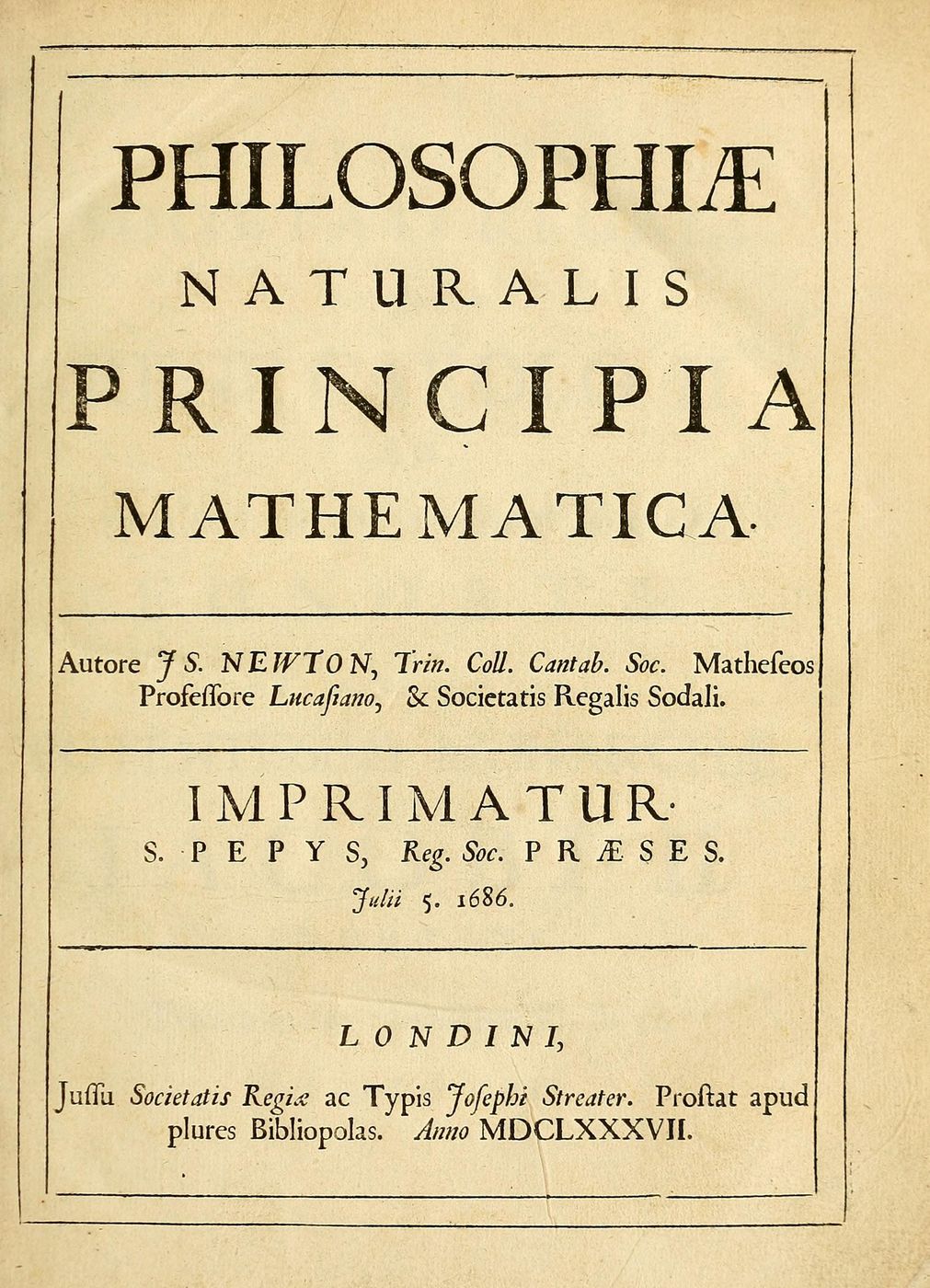
Work in Cambridge led to the Principia, published in London in 1687 with Halley’s support. It presented laws of motion and universal gravitation through mathematical arguments. The map marks Newton’s research setting, while distinguishing it from the London printing and publishing process.
Representative point for Trinity College’s historic campus buildings, approximately converted from Historic England’s grid reference TL 44696 58629. It does not identify Newton’s room. This is an institutional research-context point; the 1687 book was published in London.
Representative coordinates · 52.2069°, 0.11613°
1696
A new career at the Mint
London City-level representative point
Newton moved into public service as Warden of the Royal Mint in 1696, taking up duties at the Tower of London. He worked during a major silver recoinage and became Master in 1699. His London career therefore involved monetary administration alongside his continuing scientific reputation.
City-level London location; the Mint was then in the Tower, not its present headquarters.
Representative coordinates · 51.507°, -0.128°
Legacy and context
The Principia brought terrestrial and celestial motion into one mathematical framework. Its publication also depended on correspondence, criticism and Edmond Halley’s practical support. Newton’s later public service shows a career extending beyond university research.
Questions for a closer reading
Why do accounts give both 1642 and 1643 as Newton’s birth year?
They refer to the same birth under different calendars: 25 December 1642 in the Julian calendar then used in England corresponds to 4 January 1643 in the Gregorian calendar. Compare the full date and calendar label before treating the two years as a disagreement.
Does the Cambridge marker show where the Principia was printed?
No. Cambridge identifies the research setting associated with Newton’s college life. The Principia was published in London in 1687. Research location and publication location answer different questions; a representative campus marker cannot identify the book’s printing site.
Bibliography
- National Trust: Woolsthorpe Manor
- Trinity College: Historical overview
- Cambridge University Library: Glory and Gravity
- Trinity College Library: Principia first edition
- Royal Mint Museum: Isaac Newton
References support specific dates and context. Bibliographies are displayed as text.
Image and source
Title page of Newton’s Principia, 1687
The title page of the 1687 first edition of Newton’s Philosophiae naturalis principia mathematica, from the Dibner Library copy.
- Creator
- Isaac Newton; printer Joseph Streater
- Collection / image provider
- Smithsonian Libraries, Dibner Library · Smithsonian Libraries via Wikimedia Commons
- Source and reuse
- Source record · CC0 1.0 Universal
The source makes this image available under CC0 1.0. Consult the dedication and item-specific record below; CivAtlas adds no further restrictions.
CC0 1.0 public-domain dedication, as stated in the source record. Source credit: Isaac Newton; printer Joseph Streater. Reuse terms: CC0 1.0 Universal.