Albert Einstein
From patent examinations to new accounts of space, time and gravity.
Science and medicine
On this page
Life overview
Einstein’s work developed across German and Swiss cities before Nazi rule led him to settle in the United States. Five selected stages connect education, the 1905 papers, general relativity and the Institute for Advanced Study. A theoretical breakthrough is not reduced to one room or one instant.
Places and turning points
Dashed lines show the order of selected places, not an exact travel route.
14 March 1879
A beginning in Ulm
Ulm City-level representative point
Einstein was born in Ulm into a German Jewish family. The family soon moved to Munich, where he grew up, before later moves brought him into Swiss education. Ulm is the birthplace in this selected sequence, not the setting of his later relativity papers or university training.
City-level representative point; it does not locate a particular room, institution or travel route.
Representative coordinates · 48.401°, 9.987°
1896–1900
Studying at the Zurich Polytechnic
Zurich City-level representative point
After completing school in Aarau, Einstein entered the Polytechnic in Zurich to train as a mathematics and science teacher. He graduated in 1900. Surviving records and classmates’ notes show a student engaging with modern physics, sometimes outside his classes, rather than a thinker who had no formal scientific education.
City-level representative point; it does not locate a particular room, institution or travel route.
Representative coordinates · 47.377°, 8.542°
1905
Research alongside patent work
Bern City-level representative point
While working at the Swiss Patent Office in Bern, Einstein published papers on light quanta, Brownian motion, special relativity and mass–energy relations. These addressed different problems. His doctoral dissertation was approved by the University of Zurich in 1905; the degree was formally awarded in 1906. The city point represents his working environment, not a particular desk.
City-level representative point; it does not locate a particular room, institution or travel route.
Representative coordinates · 46.948°, 7.447°
1915
A new theory of gravitation
Berlin City-level representative point
After moving to Berlin in 1914, Einstein completed the field equations of general relativity in 1915. The theory related gravitation to the geometry of spacetime and extended beyond special relativity. Its development required years of revision; later observations tested its predictions, so publication and experimental confirmation were different stages.
City-level representative point; it does not locate a particular room, institution or travel route.
Representative coordinates · 52.52°, 13.405°
1933–1955
A new institutional home in Princeton
Princeton, New Jersey City-level representative point
After the Nazis took power, Einstein settled in the United States and joined the independent Institute for Advanced Study. He continued work on unified field theories and assisted people persecuted by the Nazi regime. Princeton became his long-term base, but neither his science nor his public concerns were confined to that city.
City-level representative point; it does not locate a particular room, institution or travel route.
Representative coordinates · 40.35°, -74.651°
Legacy and context
Special and general relativity changed the study of motion and gravitation, while his work on light quanta helped transform quantum physics. These theories depended on earlier research, mathematical collaboration and experimental tests. His Princeton institution was the Institute for Advanced Study, not a department of Princeton University.
Bibliography
- ETH Library: Albert Einstein, 1879–1955
- ETH Library: Einstein’s Studies at the Polytechnic, 1896–1900
- Institute for Advanced Study: Albert Einstein, In Brief
- Institute for Advanced Study: Albert Einstein, Past Faculty
- Nobel Prize: Albert Einstein—Facts
References support specific dates and context. Bibliographies are displayed as text.
Image and source
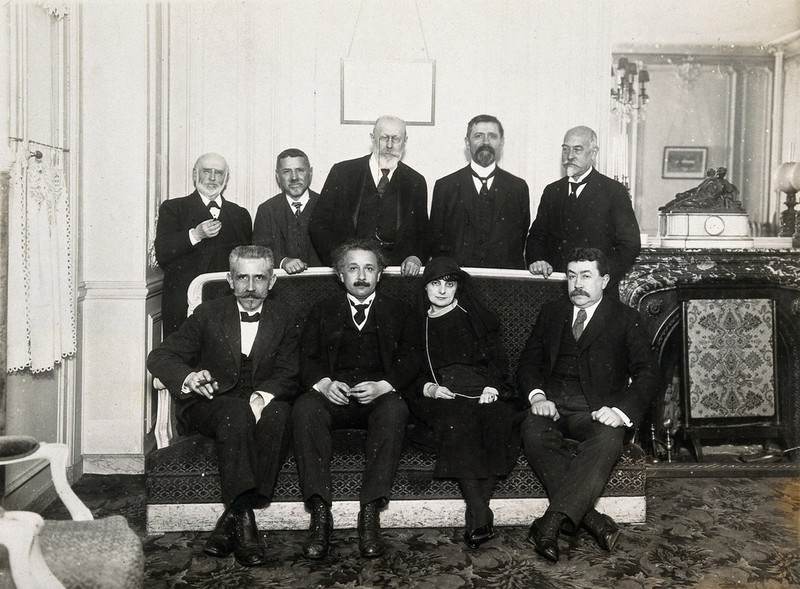
Group photograph at a luncheon for Einstein, 1922
A group photograph at a luncheon for Einstein, taken by Henri Manuel in 1922. It postdates the 1905 paper on special relativity and does not show the paper's publication.
- Creator
- Henri Manuel
- Collection / image provider
- Wellcome Collection
- Source and reuse
- Source record · Public Domain Mark
The source identifies this image as public domain. Consult its item-specific rights record and terms below; CivAtlas does not claim new copyright or grant additional rights in this image.
Public domain, as identified in the source record. Source credit: Henri Manuel. Reuse terms: Public Domain Mark.