
1915 (gravitational field equations) / Europe
General relativity connects gravity with spacetime geometry
Einstein’s field equations related matter and energy to the geometry of curved spacetime.
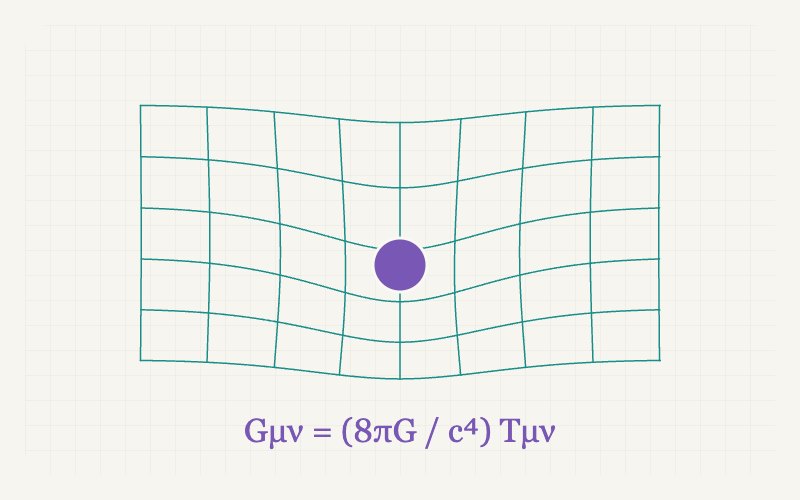
Image unavailable. The caption and source are still available.
The story
During November 1915 Einstein repeatedly revised his gravitational theory, submitting the final field equations to the Prussian Academy on 25 November. They grew from years of work on the equivalence principle, mathematical tools developed by Riemann and others, and exchanges including those with Grossmann. Mercury calculations, later eclipse observations and gravitational-wave detections were distinct developments, not experiments all completed in 1915.
Connections and context
Abstract geometry entered the description of gravity. Later astronomical observations continued testing the theory and investigating its limits.
Dates and precision
1915 (gravitational field equations) Documented date
Positioned by the documented year, month or day. Missing precision is not inferred.
Representative map location
Berlin
Berlin marks Einstein’s 1915 research and academy setting; mathematical contributions and later observations involved many other places.
Representative coordinates · 52.52°, 13.405°
A marker identifies one representative place, such as a manuscript collection, laboratory or observing site. It does not mean the work happened only there, or assign a shared discovery to one country.
Bibliography
- Caltech Einstein Papers Project: One hundred years of Einstein’s field equations
- Max Planck Institute for the History of Science: field equations, 25 November 1915
References are listed as plain bibliography titles. They support particular facts or context; a reference does not certify every interpretation in a story.