
1947 (point-contact transistor experiments) / Americas
A point-contact transistor amplifies a signal
At Bell Labs, Bardeen and Brattain used germanium and metal contacts to amplify signals, opening a new direction for semiconductor electronics.
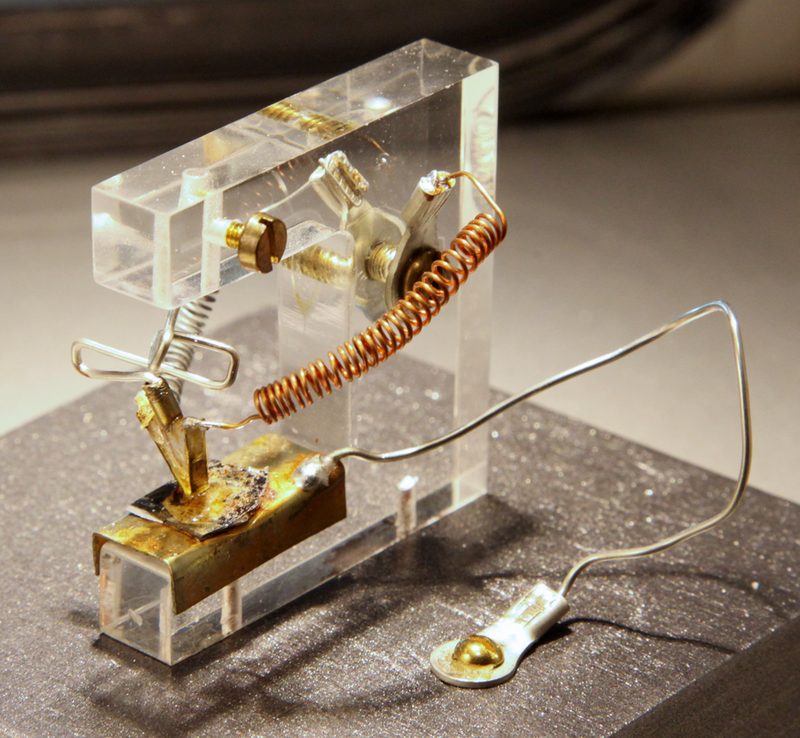
Image unavailable. The caption and source are still available.
The story
In December 1947, Bardeen and Brattain produced a working point-contact amplifier within Bell Labs’ solid-state research group and demonstrated it to laboratory managers. Shockley contributed to the group and subsequently developed a junction-transistor design. The public announcement followed in 1948. These experiments opened a path toward smaller electronic equipment, but the original device was neither an integrated circuit nor a modern chip-scale transistor.
Connections and context
Turning semiconductor physics into computing hardware required advances in materials, fabrication and circuit design. Integrated circuits would later combine multiple components and connections on one piece of material.
Dates and precision
1947 (point-contact transistor experiments) Documented date
Positioned by the documented year, month or day. Missing precision is not inferred.
Representative map location
Murray Hill, New Jersey
The marker identifies Bell Labs’ Murray Hill research site, not every later site of transistor development or manufacture.
Representative coordinates · 40.6832°, -74.4°
A marker identifies one representative place, such as a manuscript collection, laboratory or observing site. It does not mean the work happened only there, or assign a shared discovery to one country.
Bibliography
- Computer History Museum: Invention of the Point-Contact Transistor
- Nokia Bell Labs: History
References are listed as plain bibliography titles. They support particular facts or context; a reference does not certify every interpretation in a story.