
1687 (first edition) / Europe
The Principia links Earth and sky through dynamics
Newton organizes laws of motion and universal gravitation into a mathematical framework connecting terrestrial bodies, planets and moons.
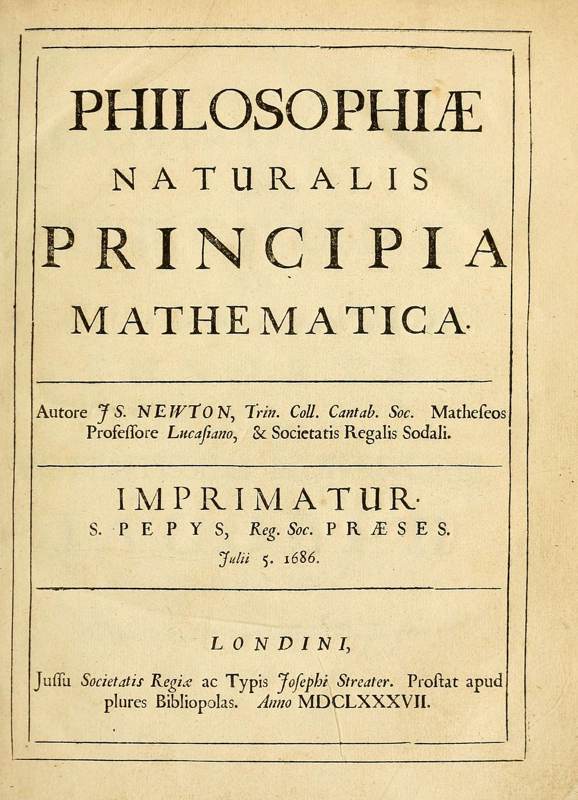
Image unavailable. The caption and source are still available.
The story
Published in London with Halley's support, the Principia combined earlier work with concentrated writing in 1684–1687. It linked orbital relationships to forces; it did not first reveal that objects fall. Its domain is limited: later physics changed explanations at high speeds and in strong gravitational fields.
Connections and context
Observations, mathematical tools and publishing collaboration supported the book. Successors extended celestial mechanics while new measurements continued testing its claims.
Dates and precision
1687 (first edition) Documented date
Positioned by the documented year, month or day. Missing precision is not inferred.
Representative map location
Cambridge (research and writing)
Newton's research and writing city; the first edition was printed in London.
Representative coordinates · 52.2°, 0.12°
A marker identifies one representative place, such as a manuscript collection, laboratory or observing site. It does not mean the work happened only there, or assign a shared discovery to one country.
Bibliography
- Cambridge University Library and University of Glasgow | The 1687 Principia and its development
- University of Glasgow | Sir Isaac Newton: Principia
References are listed as plain bibliography titles. They support particular facts or context; a reference does not certify every interpretation in a story.