
12 March 1610 (publication) / Europe
The Starry Messenger brings telescopic sights into public debate
Galileo reports an uneven Moon, countless stars and Jupiter's moons, using new observations to challenge inherited pictures of the heavens.
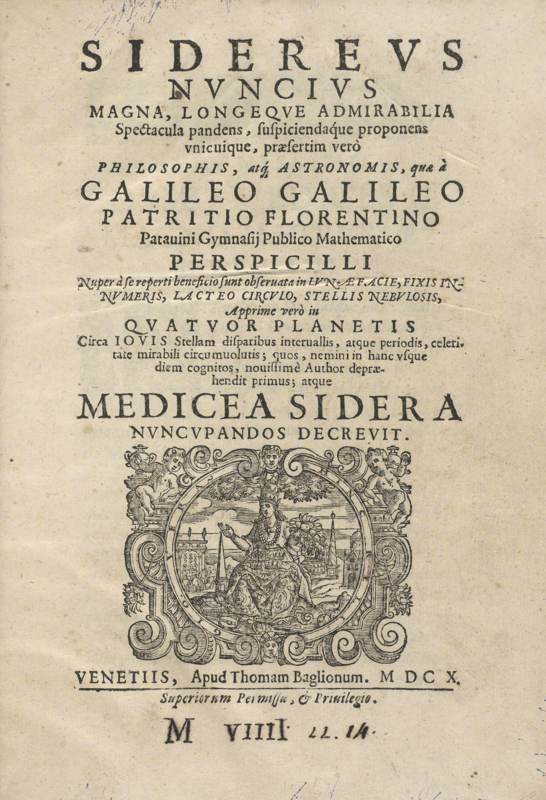
Image unavailable. The caption and source are still available.
The story
Galileo improved an existing telescope technology, observed from Padua and published in Venice. Jupiter's moons showed that not every celestial body circled Earth. These observations did not alone prove Earth's solar orbit. Instrument reliability, observing skills and competing models still required testing and debate.
Connections and context
Galileo did not invent the telescope alone. Its evidential force depended on others being able to observe and judge the phenomena too.
Dates and precision
12 March 1610 (publication) Documented date
Positioned by the documented year, month or day. Missing precision is not inferred.
Representative map location
Padua (observation)
The main observing city for the reported work; the publication date refers to printing in Venice.
Representative coordinates · 45.41°, 11.88°
A marker identifies one representative place, such as a manuscript collection, laboratory or observing site. It does not mean the work happened only there, or assign a shared discovery to one country.
Bibliography
- Museo Galileo | Sidereus nuncius and the observations of 1610
- Museo Galileo | Sidereus Nuncius, Galileo Galilei
- Library of Congress | Galileo and the Telescope
References are listed as plain bibliography titles. They support particular facts or context; a reference does not certify every interpretation in a story.