Simón Bolívar
Independence campaigns and the difficult project of political union.
Public life
On this page
Life overview
Bolívar moved between exile, military leadership and republican government across northern South America. Five places connect his Caracas origins, the Jamaica Letter, Angostura, Guayaquil and his last journey. The map follows selected appearances, not the boundaries of a personal empire.
Places and turning points
Dashed lines show the order of selected places, not an exact travel route.
24 July 1783
An elite colonial childhood
Caracas City-level representative point
Bolívar was born into a wealthy Creole family in colonial Caracas. Its property included plantations and enslaved people, placing him within the society he later helped overturn politically. His education included Simón Rodríguez’s teaching; an aristocratic upbringing should not be mistaken for an early position outside colonial privilege.
City-level representative point; it does not locate a particular room, institution or travel route.
Representative coordinates · 10.481°, -66.904°
6 September 1815
A political letter from exile
Kingston, Jamaica City-level representative point
After military reverses, Bolívar sought refuge in Jamaica. In Kingston he addressed Henry Cullen in the letter now called the Jamaica Letter, analysing Spanish American society and possible independent governments. It expressed hopes for cooperation while recognising regional differences; it was a political argument, not a prediction that events inevitably fulfilled.
City-level representative point; it does not locate a particular room, institution or travel route.
Representative coordinates · 18.018°, -76.809°
1819
Congress on the Orinoco
Angostura, now Ciudad Bolívar City-level representative point
Bolívar convened a congress at Angostura and presented a constitutional proposal. Later that year, after the New Granada campaign, the congress adopted the fundamental law of a Republic of Colombia. Military success and state-building were connected, but the proposed union still required institutions and agreement among its different regions.
City-level representative point; it does not locate a particular room, institution or travel route.
Representative coordinates · 8.129°, -63.55°
July 1822
Meeting San Martín
Guayaquil City-level representative point
Bolívar met José de San Martín in Guayaquil as the struggle over Peru’s future continued. Their talks were private, and no complete transcript survives. San Martín subsequently withdrew from the independence struggle. The meeting matters, but its undocumented dialogue should not be reconstructed as a certain bargain or a personal defeat.
City-level representative point; it does not locate a particular room, institution or travel route.
Representative coordinates · -2.171°, -79.922°
December 1830
A last journey as the union fractured
Santa Marta City-level representative point
After leaving the presidency and travelling toward the Caribbean coast, Bolívar reached Santa Marta in December. Illness prevented his intended departure for Europe, and he died at San Pedro Alejandrino on 17 December. Gran Colombia was breaking apart, exposing the gap between a continental political project and enduring regional divisions.
City-level representative point; it does not locate a particular room, institution or travel route.
Representative coordinates · 11.241°, -74.199°
Legacy and context
He helped end Spanish colonial rule across much of South America, working with armies, allies and local movements. Independence did not immediately end slavery or inequality. His preference for concentrated authority also clashed with federalist projects, and Gran Colombia was breaking apart by 1830.
Bibliography
- Rice University OpenStax: Spanish South America
- Banco de la República: Simón Bolívar
- Banco de la República: El proyecto grancolombiano
- Casa Museo Quinta de Bolívar: Simón Bolívar
- Museo Bolivariano Quinta de San Pedro Alejandrino: Simón Bolívar
References support specific dates and context. Bibliographies are displayed as text.
Image and source
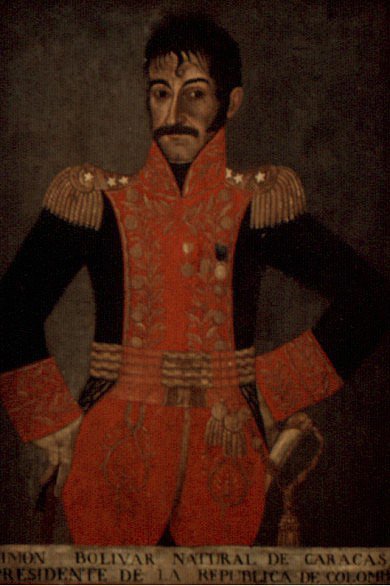
A portrait of Simón Bolívar
A nineteenth-century portrait attributed to Pedro José Figueroa. Bolívar was a leading figure in the independence wars of Spanish South America; the portrait represents a participant, rather than any one battle or proclamation.
- Creator
- Attributed to Pedro José Figueroa
- Collection / image provider
- Museo Nacional de Colombia · Wikimedia Commons
- Source and reuse
- Source record · Public domain
The source identifies this image as public domain. Consult its item-specific rights record and terms below; CivAtlas does not claim new copyright or grant additional rights in this image.
Public domain, as identified in the source record. Source credit: Attributed to Pedro José Figueroa. Reuse terms: Public domain.