Miguel de Cervantes
A writer between Mediterranean warfare, captivity and print
Thought and culture
On this page
Life overview
Cervantes’s life connected Alcalá de Henares, Mediterranean warfare, captivity in Algiers and the book trade of Castile. The publication of Don Quixote made him widely read, but gaps in his biography require care when linking fiction to lived experience.
Places and turning points
Dashed lines show the order of selected places, not an exact travel route.
1547
A documented beginning, with gaps
Alcalá de Henares City-level representative point
Cervantes was born at Alcalá de Henares in 1547. A surviving baptismal record anchors the year, while his exact birthday is inferred rather than established. Much of his early life remains incompletely documented; later fictional characters cannot fill those gaps as if they were the author’s own testimony.
City-level marker; no individual building or exact route is asserted.
Representative coordinates · 40.4817°, -3.3641°
1571
Wounded in Mediterranean warfare
Gulf of Patras — Battle of Lepanto Representative area
Serving as a soldier, Cervantes fought in the naval battle of Lepanto and suffered an injury that disabled his left hand. The battle belonged to the conflict between the Holy League and the Ottoman fleet. The regional marker identifies the maritime setting, not his ship’s precise position or a modern city street.
Regional marker in the Gulf of Patras; not a verified battle position or sailing route.
Representative coordinates · 38.3°, 21.2°
1575–1580
Five years of captivity
Algiers City-level representative point
Captured by corsairs in 1575, Cervantes spent years in captivity at Algiers before being ransomed in 1580. This episode connects his biography to Mediterranean warfare, enslavement and ransom networks. The city marker does not identify a securely documented cell, and his later literary depictions should be read separately from archival evidence.
City-level marker; no individual building or exact route is asserted.
Representative coordinates · 36.7538°, 3.0588°
1605
Living in Valladolid, publishing in Madrid
Valladolid — residence City-level representative point
Cervantes lived in Valladolid when the first part of Don Quixote appeared with a 1605 imprint. Juan de la Cuesta printed it in Madrid for bookseller Francisco de Robles. The map follows the writer’s residence; it does not relocate the printing shop or confuse a book’s publication place with its author’s home.
City-level marker; no individual building or exact route is asserted.
Representative coordinates · 41.6523°, -4.7245°
1616
Last books and a posthumous publication
Madrid City-level representative point
In his final Madrid years Cervantes published the Exemplary Novels and the second part of Don Quixote. He died in 1616, after dedicating The Trials of Persiles and Sigismunda, which appeared posthumously. The year marker avoids confusing the date of his death with the burial commemorated on 23 April.
City-level marker; no individual building or exact route is asserted.
Representative coordinates · 40.4168°, -3.7038°
Legacy and context
Don Quixote and his other writing have reached readers through generations of editions and translations. His literary narrators are not direct autobiographical testimony, and his fame should not turn uncertain episodes into established facts.
Bibliography
- Spanish Ministry of Culture: Cervantes, between myth and reality (Spanish)
- Universitat de València, ASODAT: Cervantes biography (Spanish)
- Museo Casa de Cervantes: Cervantes in Valladolid (Spanish)
- Instituto Nacional de Estadística: following Cervantes’s footsteps (Spanish)
References support specific dates and context. Bibliographies are displayed as text.
Image and source
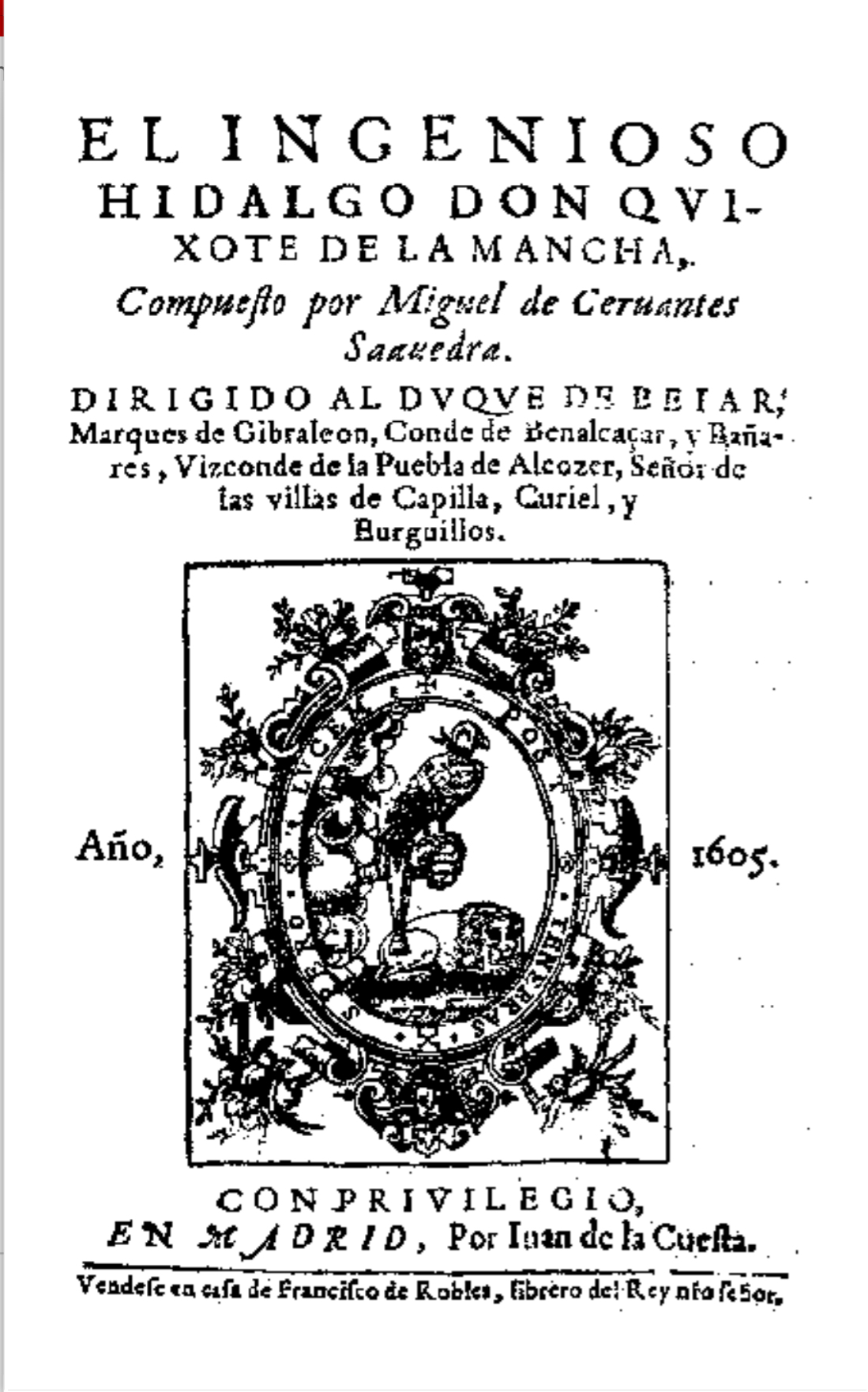
Don Quixote, first-part title page, 1605 edition
Title page of the first part of Don Quixote, with the Madrid imprint of Juan de la Cuesta and bookseller Francisco de Robles. It represents Cervantes’s published work, not his face. The edition is dated 1605; printing was completed in late 1604.
- Creator
- Miguel de Cervantes Saavedra (author); Juan de la Cuesta (printer); Francisco de Robles (bookseller/publisher)
- Collection / image provider
- 1605 Madrid edition; physical copy and digitizer not identified in the Commons file · Wikimedia Commons
- Source and reuse
- Source record · Public Domain Mark 1.0 / PD-old-70-expired
The source identifies this image as public domain. Consult its item-specific rights record and terms below; CivAtlas does not claim new copyright or grant additional rights in this image.
Public domain, as identified in the source record. Source credit: Miguel de Cervantes Saavedra (author); Juan de la Cuesta (printer); Francisco de Robles (bookseller/publisher). Reuse terms: Public Domain Mark 1.0 / PD-old-70-expired.