Sima Qian
Travel, court records and the writing of the Shiji
Thought and culture
On this page
Life overview
Sima Qian was a Western Han historian whose Shiji brought rulers, institutions and individual lives into a general history. Travel, family learning and access to court records informed his work. His birth year is disputed between approximately 145 and 135 BCE, and his death year is not securely known.
Places and turning points
Dashed lines show the order of selected places, not an exact travel route.
c.145 BCE; another tradition gives c.135 BCE
Origins at Xiayang
Xiayang, near present-day Hancheng Representative area
Sima Qian came from Xiayang, south of present-day Hancheng. His father Sima Tan’s learning and official responsibilities formed part of his intellectual background. The birth date is disputed: approximately 145 and 135 BCE are the two principal proposals. The regional marker does not establish a surviving birth house.
City-level reference; the marker does not identify a particular room or building.
Representative coordinates · 35.383°, 110.454°
c.125 BCE under the 145 BCE birth chronology
Travel and the collection of local traditions
Kuaiji, present-day Shaoxing City-level representative point
Sima Qian’s account describes travel at about twenty, including a visit to Kuaiji and the traditional site associated with Yu. The journey broadened the geographical and oral materials available to him. Its date depends on his disputed birth year: approximately 125 BCE under one chronology, or 115 BCE under the other.
City-level reference; the marker does not identify a particular room or building.
Representative coordinates · 30°, 120.582°
110 BCE (Yuanfeng first year)
Receiving his father’s historical project
Luoyang City-level representative point
When Sima Tan became ill at Luoyang, Sima Qian met him after returning from the southwest. His father urged him to continue the family’s historical undertaking. This episode connects personal obligation with the later Shiji, but does not mean the complete surviving work had already been planned or written at Luoyang.
City-level reference; the marker does not identify a particular room or building.
Representative coordinates · 34.6197°, 112.454°
108 BCE
Appointment as Grand Historian
Chang’an, Han capital City-level representative point
Sima Qian succeeded to the office of taishi ling, whose responsibilities included astronomy and the calendar as well as record-keeping. The position placed him within the Han court’s documentary world. Calling him simply a modern-style national librarian would obscure both the astronomical duties and the different institutions of the period.
City-level reference; the marker does not identify a particular room or building.
Representative coordinates · 34.3416°, 108.9398°
104–c.91 BCE (approximate writing period)
Calendar reform and the Shiji
Chang’an City-level representative point
Sima Qian participated in the calendar reform that produced the Taichu calendar and pursued his historical writing. The Shiji combined annals, tables, treatises and biographies, including accounts of Qin. Work continued through personal adversity. The period is a conventional writing range, not an exact publication date or a secure endpoint for his life.
City-level reference; the marker does not identify a particular room or building.
Representative coordinates · 34.3416°, 108.9398°
Legacy and context
The Shiji established an influential biographical approach to history. Its annals, tables and thematic studies allow different ways of comparing evidence. Approximate dates remain approximate, and the conventional writing period cannot establish the author’s unknown year of death.
Bibliography
- 故宫博物院:司马迁 (Chinese source)
- 陕西师范大学档案馆:风追司马 史记千秋 (Chinese source)
- 国家图书馆:史记导读(试读PDF) (Chinese source)
- 文史广东:司马迁与中国人的日历 (Chinese source)
- 旌德县人民政府:水旱灾害防御知识普及篇 (Chinese source)
References support specific dates and context. Bibliographies are displayed as text.
Image and source
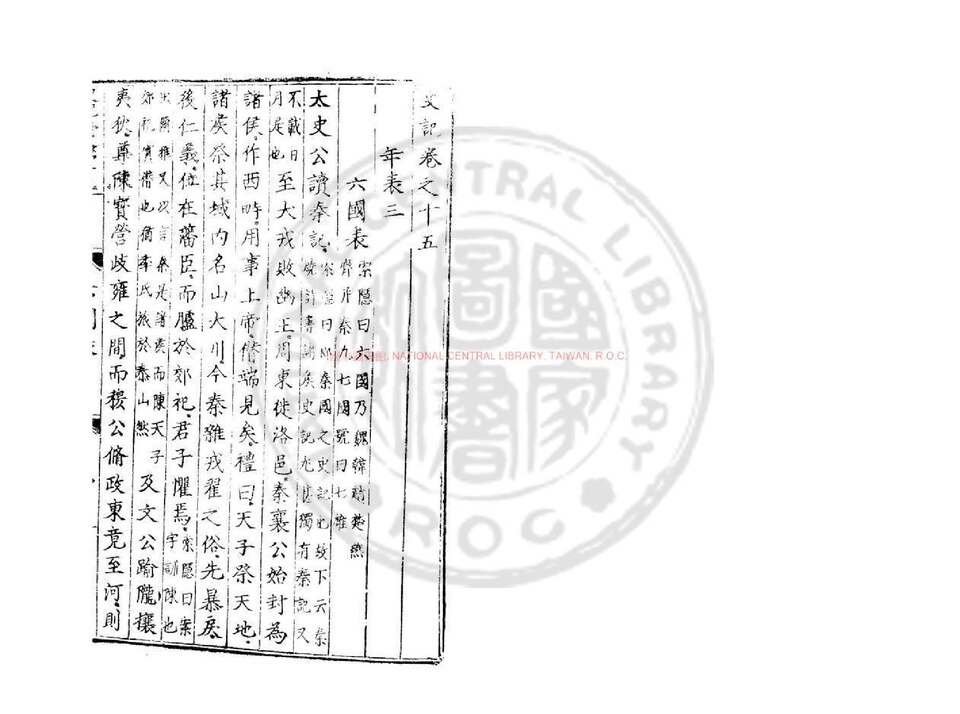
A Ming printed edition of Sima Qian’s Shiji
A page from a Shiji edition printed in 1518 and revised in 1521, preserved by the National Central Library, Taipei. This is a much later printed transmission of Sima Qian’s work, not his manuscript or portrait. The provider’s library watermark is retained.
- Creator
- Sima Qian (text); Ming printed edition with later commentaries; scanner not named
- Collection / image provider
- National Central Library, Taipei · Wikimedia Commons
- Source and reuse
- Source record · Public Domain Mark 1.0
The source identifies this image as public domain. Consult its item-specific rights record and terms below; CivAtlas does not claim new copyright or grant additional rights in this image.
Public domain, as identified in the source record. Source credit: Sima Qian (text); Ming printed edition with later commentaries; scanner not named. Reuse terms: Public Domain Mark 1.0.