Thought and culture / 1452–1519
Leonardo da Vinci
Drawing linked painting, observation and the making of things.
Life overview
Leonardo moved among workshops, courts and patrons in the Italian peninsula before his final years in France. Five selected stages trace these changing settings. His drawings and notebooks connect artistic practice with investigations of bodies, water, mechanisms and the natural world.
Places and turning points
Dashed lines show the order of selected places, not an exact travel route.
1472
A recognised painter in Florence
Florence City-level representative point
Records place Leonardo in Florence’s painters’ confraternity in 1472, after training in Verrocchio’s workshop. That setting combined painting with materials, sculpture and other skilled work. The stage marks recognition as a painter rather than his birth or the beginning of every interest later visible in his notebooks.
City-level Florence location; not the exact entrance of a reconstructed workshop.
Representative coordinates · 43.7696°, 11.2558°
Around 1482–1499
Working for the Milanese court
Milan City-level representative point
Around 1482, Leonardo began his first long Milanese period. Court commissions included paintings, designs and the Last Supper, painted in the 1490s. He also pursued technical studies and reading. Such work connected workshop skills, patrons and books, rather than separating art from the investigation of nature.
City-level Milan location; “around 1482” preserves uncertainty in the beginning of this period.
Representative coordinates · 45.4642°, 9.19°
From 1500
Returning to Florence
Florence City-level representative point
Leonardo returned to Florence in 1500 after leaving Milan and making other stops. New commissions and studies followed, including work associated with the Mona Lisa and investigations of water. This return shares a city point with his earlier career; it does not imply an uninterrupted residence until the next selected stage.
Same Florence point as 1472; later Milanese stays and shorter journeys are omitted from this selection.
Representative coordinates · 43.7696°, 11.2558°
1513–1516
A later setting in Rome
Rome City-level representative point
Leonardo spent a later phase of his career in Rome, from 1513 until his move to France. The change of city placed his projects within another setting of patronage. These selected stages omit a second Milanese period and shorter journeys; their sequence cannot establish a direct route from Florence to Rome.
City-level Rome location; the connecting line omits intermediate residences and is not a travel route.
Representative coordinates · 41.9028°, 12.4964°
1516–1519
Final years near Amboise
Amboise, Clos Lucé City-level representative point
Leonardo settled at Clos Lucé near the French royal court at Amboise in 1516, bringing paintings and manuscripts. He continued revising work and developing projects under royal patronage. He died there in 1519. This final residence does not mean that every painting or machine associated with him originated in France.
Amboise city-level location for the Clos Lucé residence; not a room-level historical reconstruction.
Representative coordinates · 47.413°, 0.982°
Legacy and context
His paintings and surviving manuscripts reveal repeated observation, revision and ambitious projects, many left unfinished. A drawing of a machine is not evidence that the machine was built or worked. His career also shows how commissions, skilled collaborators and patrons shaped Renaissance knowledge.
Bibliography
- The Metropolitan Museum of Art: Leonardo da Vinci
- Clos Lucé: Leonardo da Vinci’s final residence
References support specific dates and context. Bibliographies are displayed as text.
Image and source
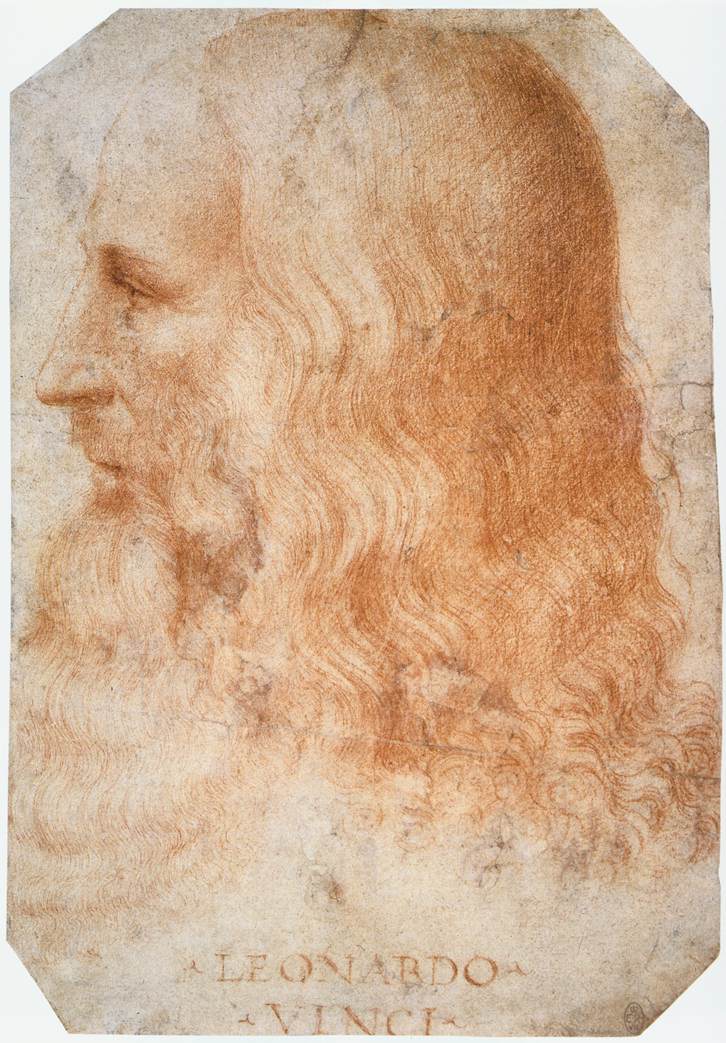
Portrait of Leonardo da Vinci, attributed to Francesco Melzi
A red-chalk profile drawing dated about 1515–1518 by the Royal Collection and attributed to Leonardo’s pupil Francesco Melzi. The artist attribution remains qualified.
- Creator
- Attributed to Francesco Melzi
- Collection / image provider
- Royal Collection, United Kingdom (RCIN 912726) · Wikimedia Commons; Web Gallery of Art reproduction
- Source and reuse
- Source record · Public Domain Mark 1.0 (PD-Art)
The source identifies this image as public domain. Consult its item-specific rights record and terms below; CivAtlas does not claim new copyright or grant additional rights in this image.
Public domain, as identified in the source record. Source credit: Attributed to Francesco Melzi. Reuse terms: Public Domain Mark 1.0 (PD-Art).