Journeys and exchange / 1304–c. 1368/1369 · 1377 also proposed
Ibn Battuta
A pilgrim’s journeys, recalled and edited as a book
Life overview
Leaving Tangier for the pilgrimage to Mecca, Ibn Battuta travelled through interconnected courts, ports and centres of learning. These five stops select parts of a much longer life. The resulting Rihla mixes remembered experience with literary editing and reports from others.
Places and turning points
Dashed lines show the order of selected places, not an exact travel route.
1325
Leaving Tangier for the pilgrimage
Tangier, Morocco City-level representative point
Ibn Battuta left his home city in 1325 intending to make the pilgrimage to Mecca. Travelling east through North Africa brought him into caravans and networks of hospitality. What became a long series of journeys began with a religious obligation, rather than a single plan to survey the world.
City-level Tangier reference; no house, departure gate or exact first-day route is identified.
Representative coordinates · 35.7595°, -5.834°
1326
Reaching Mecca and meeting scholars
Mecca, Arabian Peninsula City-level representative point
After travelling through Egypt and the Levant, Ibn Battuta reached Mecca for the pilgrimage in 1326. He performed the rites and spent time among scholars and other travellers. Repeated returns made Mecca a recurring centre of his journeys, connecting religious study with wider networks of movement and hospitality.
City-level Mecca reference; it does not reconstruct individual rituals or claim the modern cityscape matches the medieval one.
Representative coordinates · 21.3891°, 39.8579°
c. 1334–1341
Serving as a judge in Delhi
Delhi, Indian subcontinent City-level representative point
Ibn Battuta spent several years in the service of Sultan Muhammad ibn Tughluq as a judge. His account describes patronage, obligations and the hazards of court life. The stage uses an approximate Delhi chronology, not a claim that all dates in the retrospectively edited narrative can be reconciled without difficulty.
Delhi is a city-level reference; neither his house nor a particular court building is securely pinned here.
Representative coordinates · 28.6139°, 77.209°
Around 1353 · within the 1352–1353 journey
Through Mali and Timbuktu
Timbuktu, West Africa City-level representative point
During his West African journey, Ibn Battuta visited Mali’s court and passed through Timbuktu on the return. His observations describe trade, religious life and customs through the eyes of a visiting Muslim jurist. Timbuktu’s better-known later scholarly prominence should not be projected unchanged onto the town he encountered.
City-level Timbuktu reference; this is not the location of Mali’s disputed royal capital or a mapped Sahara caravan track.
Representative coordinates · 16.7666°, -3.0026°
1354–1355
Turning remembered journeys into the Rihla
Fez, Morocco City-level representative point
Back in Morocco, Ibn Battuta dictated his journeys to Ibn Juzayy under royal patronage. The resulting Rihla combined recollection, reported information and passages drawn from earlier travel literature. Its collaborative production explains why a vivid story is not automatically an eyewitness record, and why some geographical and chronological claims need separate checking.
City-level Fez reference; no particular room for the dictation or a securely identified burial site is mapped.
Representative coordinates · 34.0331°, -5.0003°
Legacy and context
His travel account offers a rich, situated view of fourteenth-century societies. Its value grows when readers distinguish witnessed episodes, reported information, conventional storytelling and later editorial choices.
Bibliography
- UC Berkeley ORIAS: The Travels of Ibn Battuta
- UC Berkeley ORIAS: Writing the Rihla
- MIT Libraries: Early Arabic Sources, Places
References support specific dates and context. Bibliographies are displayed as text.
Image and source
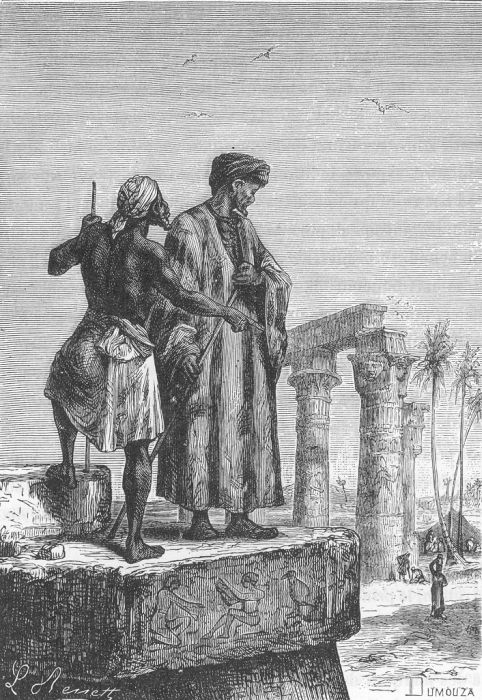
Ibn Battuta in Egypt: an 1878 book illustration
Léon Benett’s illustration for Jules Verne’s Découverte de la terre, published in 1878. It imagines Ibn Battuta with a guide in Egypt centuries after his travels; it is not a contemporary portrait.
- Creator
- Léon Benett (illustrator); Jules Verne (book author)
- Collection / image provider
- Holding institution not specified in the selected Commons scan record · Wikimedia Commons (scan of Découverte de la terre)
- Source and reuse
- Source record · Public Domain Mark 1.0 (PD-scan)
The source identifies this image as public domain. Consult its item-specific rights record and terms below; CivAtlas does not claim new copyright or grant additional rights in this image.
Public domain, as identified in the source record. Source credit: Léon Benett (illustrator); Jules Verne (book author). Reuse terms: Public Domain Mark 1.0 (PD-scan).