
Journeys and exchange / c. 600 or 602–664 · birth year disputed
Xuanzang: Life Timeline, Buddhist Study and Translation
Xuanzang’s biography links a search for Buddhist texts with the work of translating them after his return. Read the selected stages as a chronology of learning and collaboration, keeping uncertain dates and the later literary story distinct.
Read the dates before calculating a journey
A timeline needs an order, but its ordering year is not always a settled date. This biography keeps 629 and 627 as competing departure chronologies and labels approximate stages. The return in 645 belongs to a different part of that evidence. Subtracting one displayed number from another would conceal those qualifications; compare the date labels before assigning an exact journey length or age.
Written accounts and surviving objects answer different questions
A travel account can describe places and learning, while an inscribed Buddhist pedestal from Yuhua gives material evidence for Xuanzang’s later years. Each supports a limited claim. Neither supplies a complete track between every mapped point. Likewise, Nalanda’s surviving archaeological site anchors the place geographically without identifying his classroom. Reading these forms of evidence together makes both the journey and the translation career clearer.
Life overview
Xuanzang crossed Central Asia to study Buddhist texts in South Asia and returned to Tang China with manuscripts. His later translation work was a substantial second career. This selected itinerary distinguishes the historical monk from the fictional pilgrim and keeps competing chronologies visible.
Places and turning points
Dashed lines show the order of selected places, not an exact travel route.
629 in one chronology; 627 in another
Leaving Chang’an to seek texts
Chang’an, present-day Xi’an City-level representative point
Xuanzang left Chang’an to study Buddhist teachings in their South Asian setting and seek texts that could clarify disagreements he had encountered. Sources differ on the departure year: the itinerary uses 629 for ordering, while a National Museum of China account gives 627. Neither date is silently treated as settled.
Modern Xi’an is a city-level reference for Tang Chang’an; no departure gate or exact road is asserted.
Representative coordinates · 34.3416°, 108.9398°
Around 629–630 · approximate chronology
An oasis stage at Gaochang
Gaochang, Turpan basin Representative area
The westward journey passed through Gaochang in the Turpan basin before continuing through other oasis states. This stage makes the geography of Central Asian travel visible: settlements and passages formed a network, not one uniform road. The marker identifies a regional stop, without assigning an exact arrival day or reconstructing his movements inside the oasis.
Turpan-basin representative point; it does not mark a documented lodging, palace or exact ancient route.
Representative coordinates · 42.95°, 89.18°
Around the 630s · approximate stage
Studying at Nalanda
Nalanda, present-day Bihar Documented site
At Nalanda, Xuanzang studied Buddhist philosophy with teachers including Shilabhadra. His years in South Asia also included journeys beyond this centre of learning; the map does not imply an uninterrupted residence throughout the decade. Learning languages and comparing teachings prepared him for the translation work he would later organise in China.
UNESCO’s published representative coordinates for the archaeological site of Nalanda Mahavihara. They identify the surviving site, not Xuanzang’s particular classroom, residence or walking route. The historical institution was larger than today’s protected remains.
Representative coordinates · 25.1366666667°, 85.4438888889°
645
Returning with manuscripts
Chang’an, present-day Xi’an City-level representative point
Xuanzang returned to Chang’an in 645 with Buddhist manuscripts. Collecting books was only the beginning of their use: translation required teams who could interpret, write, check and copy texts. With imperial support, he organised this work after his return. His account of the Western Regions also preserved geographical descriptions from his journeys.
The return uses the same Xi’an reference point; ancient temple compounds are not inferred from the city marker.
Representative coordinates · 34.3416°, 108.9398°
659–664
Completing his final translations at Yuhua
Yuhua Temple, Tongchuan area City-level representative point
In 659 Xuanzang moved from Chang’an to Yuhua Temple in the Tongchuan area, continuing translation until his death in 664. A dated inscribed Buddhist pedestal recovered at the site provides material evidence connected with his later years. This final relocation matters: not all of his post-return translation career took place in Chang’an.
Modern Tongchuan is a city-level orientation point; the marker is not the excavated pedestal’s findspot or the temple’s exact position.
Representative coordinates · 34.8971°, 108.9452°
Legacy and context
His translations and account of the Western Regions became important sources for Buddhist thought and historical geography. They also reflect the purposes and knowledge of a seventh-century Buddhist traveller.
Questions for a closer reading
Why are both 600 and 602 given as his birth year?
The cited Chinese accounts preserve different birth chronologies. The profile keeps both rather than presenting one as proven. A number used to arrange the life map does not resolve that disagreement, and ages calculated from it should retain the same uncertainty.
How does this biography differ from Journey to the West?
The historical biography follows a monk’s study, manuscripts and translation work. Journey to the West is a later literary reworking with fantastic episodes. It can help explain Xuanzang’s cultural afterlife, but it cannot establish the dates or precise places of his seventh-century travels.
Bibliography
- National Museum of China: Xuanzang’s translations (Chinese)
- Xinjiang Academy of Social Sciences: Xuanzang and Khotan (Chinese)
- British Library IDP: Buddhist travellers and pilgrims
References support specific dates and context. Bibliographies are displayed as text.
Image and source
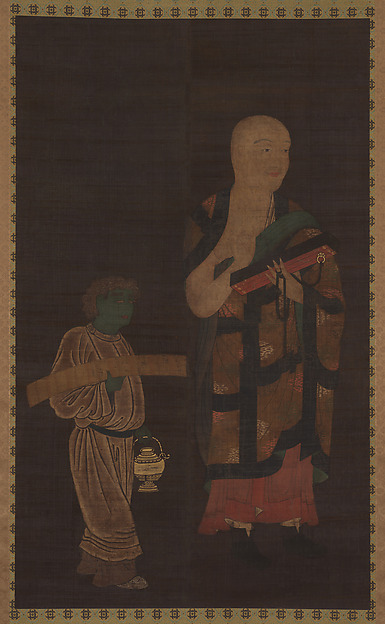
Portrait of Xuanzang with an attendant, 14th century
A 14th-century Japanese devotional painting in the style of Kasuga Motomitsu, showing Xuanzang with an attendant. This later depiction does not record his appearance during his lifetime.
- Creator
- In the style of Kasuga Motomitsu (as catalogued by The Metropolitan Museum of Art)
- Collection / image provider
- The Metropolitan Museum of Art, New York · The Metropolitan Museum of Art Open Access
- Source and reuse
- Source record · CC0 1.0 Universal
The source makes this image available under CC0 1.0. Consult the dedication and item-specific record below; CivAtlas adds no further restrictions.
CC0 1.0 public-domain dedication, as stated in the source record. Source credit: In the style of Kasuga Motomitsu (as catalogued by The Metropolitan Museum of Art). Reuse terms: CC0 1.0 Universal.