Cleopatra VII
A Ptolemaic ruler negotiating Roman power
Public life
On this page
Life overview
Cleopatra VII governed Egypt during Rome’s civil wars. Her diplomacy, dynastic claims and control of resources mattered alongside alliances with Caesar and Antony; romantic retellings often obscure that political setting.
Places and turning points
Dashed lines show the order of selected places, not an exact travel route.
51 BCE
An uneasy dynastic succession
Alexandria City-level representative point
Cleopatra succeeded Ptolemy XII and initially ruled with her brother Ptolemy XIII. The Ptolemaic monarchy combined a Greek-speaking court with Egyptian religious kingship. Rival factions soon challenged the arrangement. Accession therefore began a struggle over royal authority, not an uninterrupted period of independent personal control.
City-level marker; no individual building is asserted.
Representative coordinates · 31.2°, 29.918°
48–47 BCE
Seeking support during a civil war
Alexandria City-level representative point
Driven from power by a rival court faction, Cleopatra sought Caesar’s support when he arrived in Alexandria. The resulting war entangled Egypt’s succession with Rome’s civil conflict. Caesar’s victory restored her position, but dependence on Roman intervention also exposed the limits within which the Ptolemaic monarchy now operated.
City-level marker; no individual building is asserted.
Representative coordinates · 31.2°, 29.918°
44 BCE
A kingdom after Caesar’s assassination
Alexandria City-level representative point
Caesar’s murder removed a powerful supporter and reopened uncertainty in Roman politics. Cleopatra returned to Egypt and continued dynastic government there. Her son Caesarion’s position linked the future of the royal house to contested claims about Caesar, but such claims did not give Egypt control over Rome’s succession.
City-level marker; no individual building is asserted.
Representative coordinates · 31.2°, 29.918°
41 BCE
Negotiating with Antony
Tarsus City-level representative point
Cleopatra met Mark Antony at Tarsus as he organised Rome’s eastern territories. Both had political reasons to cooperate: Antony needed resources and regional allies, while Cleopatra sought security for her dynasty. Later accounts turned the meeting into spectacle and romance, often displacing the negotiations and unequal balance of power.
City-level marker; no individual building is asserted.
Representative coordinates · 36.916°, 34.891°
30 BCE
The end of the Ptolemaic kingdom
Alexandria City-level representative point
After defeat at Actium in 31 BCE, Cleopatra and Antony lost their struggle against Octavian. Alexandria fell the following year, and both died. Egypt passed into Roman rule. The precise method of Cleopatra’s death and the location of her tomb remain uncertain; later dramatic versions cannot settle those questions.
City-level marker; no individual building is asserted.
Representative coordinates · 31.2°, 29.918°
Legacy and context
Coins, monuments and hostile Roman texts preserve different views of her rule. Her defeat ended the Ptolemaic kingdom, but later stereotypes cannot substitute for evidence about her government.
Bibliography
- Rosicrucian Egyptian Museum: Cleopatra VII
- Cambridge University Press: Profiling Cleopatra
- UCL: Cleopatra VII — selected facts; see research notes
References support specific dates and context. Bibliographies are displayed as text.
Image and source
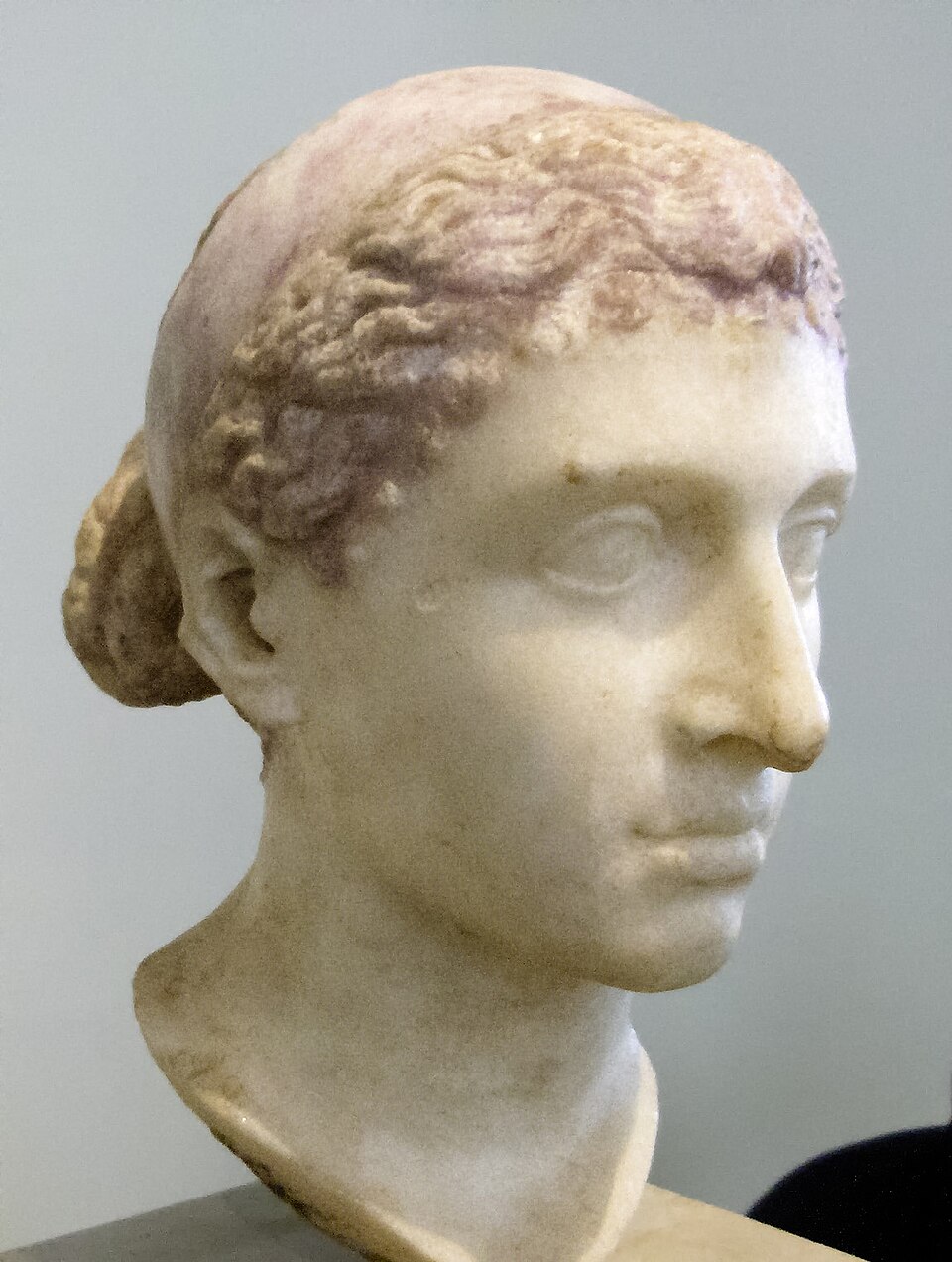
Ancient marble portrait identified as Cleopatra VII
Photograph by Louis le Grand of the ancient marble portrait in Berlin’s Altes Museum, catalogued around 40–30 BCE. The royal diadem supports its identification; an idealised sculpture is not a photographic record of the queen’s appearance.
- Creator
- Louis le Grand (photograph); ancient sculptor not named
- Collection / image provider
- Antikensammlung Berlin, Altes Museum · Wikimedia Commons
- Source and reuse
- Source record · Public Domain Mark 1.0
The source identifies this image as public domain. Consult its item-specific rights record and terms below; CivAtlas does not claim new copyright or grant additional rights in this image.
Public domain, as identified in the source record. Source credit: Louis le Grand (photograph); ancient sculptor not named. Reuse terms: Public Domain Mark 1.0.