
1888 (wave experiments and papers) / Europe
Hertz investigates electromagnetic waves with spark apparatus
Transmitting and receiving circuits revealed propagation, reflection, standing waves and polarization of electromagnetic disturbances.
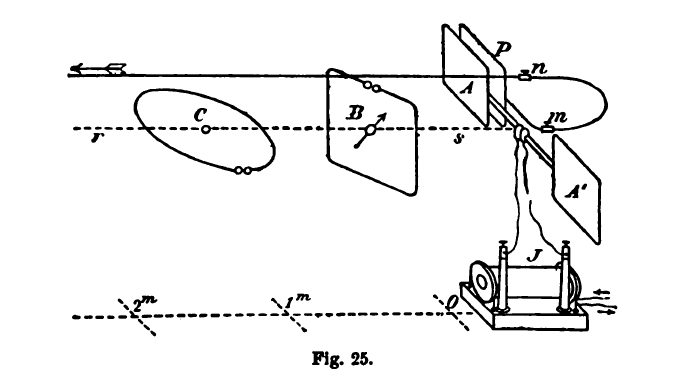
Image unavailable. The caption and source are still available.
The story
Working in Karlsruhe, Hertz began rapid-oscillation experiments in 1886 and investigated propagation, interference and reflection through 1887–1888. Papers and experiments in 1888 strengthened the connection with Maxwell’s theory; this entry does not date the earliest experiments to that year. Spark detectors were not yet mature radio communication systems, which required further engineering development.
Connections and context
The field theory gained new experimental support, while tools for producing and detecting waves helped prepare radio technology.
Dates and precision
1888 (wave experiments and papers) Documented date
Positioned by the documented year, month or day. Missing precision is not inferred.
Representative map location
Karlsruhe
The point identifies Hertz’s teaching and experimental setting in 1885–1889, not a later radio-telegraph installation.
Representative coordinates · 49.0069°, 8.4037°
A marker identifies one representative place, such as a manuscript collection, laboratory or observing site. It does not mean the work happened only there, or assign a shared discovery to one country.
Bibliography
- Fraunhofer Heinrich Hertz Institute: chronology of Hertz’s experiments, 1886–1889
- Karlsruhe Institute of Technology: 125 years of the discovery of electromagnetic waves
References are listed as plain bibliography titles. They support particular facts or context; a reference does not certify every interpretation in a story.