
1874 (paper published) / Europe
Cantor proves that infinite collections can differ in size
Cantor showed that real algebraic numbers can be listed, while the real numbers in an interval cannot all be listed in this way.
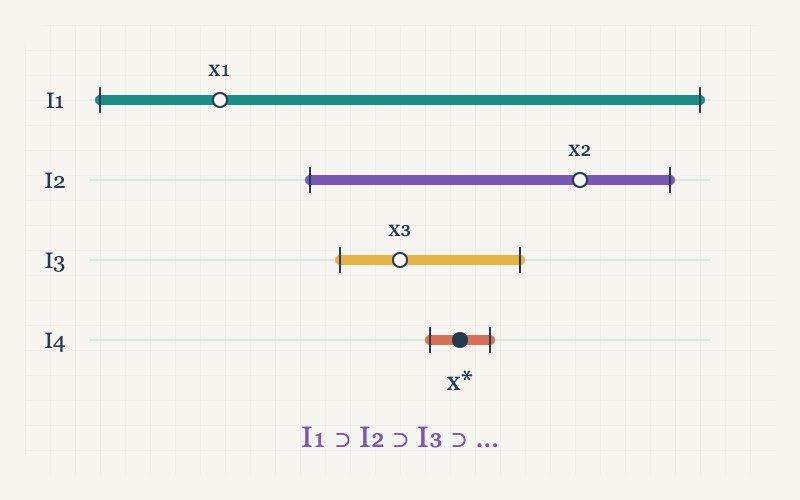
Image unavailable. The caption and source are still available.
The story
His 1874 paper combined countability of real algebraic numbers with uncountability of the reals, also establishing the existence of transcendental numbers. The argument had taken shape in correspondence with Dedekind in 1873. The familiar diagonal argument belongs to later work in 1891, not this paper; axiomatic set theory and its responses to paradoxes also developed afterwards.
Connections and context
Correspondence and proof made comparisons between infinite collections precise, contributing to the language of mathematical foundations.
Dates and precision
1874 (paper published) Documented date
Positioned by the documented year, month or day. Missing precision is not inferred.
Representative map location
Halle
Halle represents Cantor’s teaching and research setting; correspondence with Dedekind was part of the development.
Representative coordinates · 51.4825°, 11.9705°
A marker identifies one representative place, such as a manuscript collection, laboratory or observing site. It does not mean the work happened only there, or assign a shared discovery to one country.
Bibliography
- Georg Cantor: On a Property of the Class of all Real Algebraic Numbers (1874), translated by C. P. Grant
- University of St Andrews: Georg Cantor
References are listed as plain bibliography titles. They support particular facts or context; a reference does not certify every interpretation in a story.