Wu Zetian
From Tang empress to ruler of Zhou
Public life
On this page
Life overview
Wu Zetian moved from the Tang imperial household into direct government, ruled as empress dowager and proclaimed her own Zhou dynasty in 690. The five stages focus on documented offices and political centres, without locating a disputed birthplace or reproducing court legends as facts.
Places and turning points
Dashed lines show the order of selected places, not an exact travel route.
655
Becoming empress of Tang
Chang’an, present-day Xi’an City-level representative point
Emperor Gaozong made Wu his empress in 655 after removing Empress Wang. The appointment gave her an established position within the imperial household and became a basis for later political involvement. It was not yet the beginning of a separate dynasty or of her own reign as emperor.
City-level reference; the marker does not identify a particular room or building.
Representative coordinates · 34.3416°, 108.9398°
674
The title Tianhou and policy proposals
Chang’an City-level representative point
Gaozong and Wu adopted the titles Tianhuang and Tianhou, known together as the Two Sages. Wu also submitted a set of policy proposals addressing such matters as agriculture, burdens on households and official conduct. These episodes show expanding political influence while Gaozong remained emperor, not formal joint emperorship.
City-level reference; the marker does not identify a particular room or building.
Representative coordinates · 34.3416°, 108.9398°
684
Governing as empress dowager
Luoyang City-level representative point
After Gaozong’s death, Wu exercised authority as empress dowager. In 684 she deposed Zhongzong, installed Ruizong and retained control of government; Luoyang was renamed Shendu, the Divine Capital. The change in the city’s status accompanied a reorganization of court power before the formal proclamation of Zhou.
City-level reference; the marker does not identify a particular room or building.
Representative coordinates · 34.6197°, 112.454°
690
Proclaiming the Zhou dynasty
Luoyang, then Shendu City-level representative point
Wu took the imperial title and changed the dynastic name from Tang to Zhou, with Luoyang as her political centre. This was a formal change of ruler and dynasty, beyond her previous regency. Her administration used existing institutions while adjusting recruitment and court authority; it did not erase all Tang continuities.
City-level reference; the marker does not identify a particular room or building.
Representative coordinates · 34.6197°, 112.454°
705
Abdication and death
Luoyang City-level representative point
A palace coup led by Zhang Jianzhi and allied officials forced Wu to relinquish power in 705. Zhongzong returned to the throne and the Tang name was restored. Wu died later that year in Luoyang; her subsequent burial with Gaozong at Qianling was a separate event and place.
City-level reference; the marker does not identify a particular room or building.
Representative coordinates · 34.6197°, 112.454°
Legacy and context
Her reign raises questions about succession, recruitment and the exercise of imperial authority. Chang’an and Luoyang were distinct political centres; the map presents selected activities, not a territorial outline or a complete catalogue of her policies.
Bibliography
- 中国文化研究院:武则天(吴宗国顾问、邹重华审订) (Chinese source)
References support specific dates and context. Bibliographies are displayed as text.
Image and source
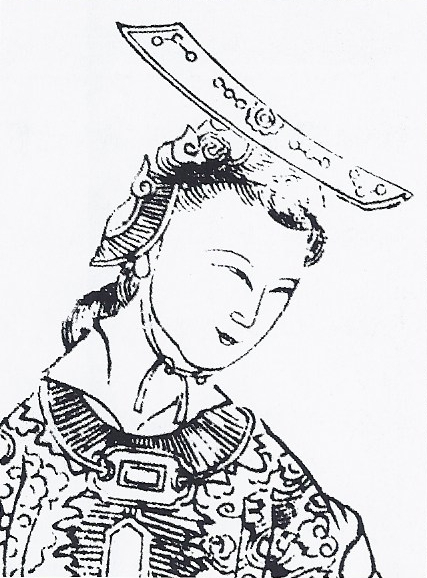
Wu Zetian in the Wushuang Pu, c. 1690
A later depiction of Wu Zetian from the Wushuang Pu, compiled by Jin Guliang and engraved by Zhu Gui around 1690. It was made nearly a millennium after her lifetime and does not establish her appearance.
- Creator
- Jin Guliang (compiler and draughtsman); Zhu Gui (engraver)
- Collection / image provider
- Wushuang Pu, c. 1690; holding institution not specified in the selected scan · Wikimedia Commons
- Source and reuse
- Source record · Public Domain Mark 1.0
The source identifies this image as public domain. Consult its item-specific rights record and terms below; CivAtlas does not claim new copyright or grant additional rights in this image.
Public domain, as identified in the source record. Source credit: Jin Guliang (compiler and draughtsman); Zhu Gui (engraver). Reuse terms: Public Domain Mark 1.0.