Suleiman I
Ottoman law, imperial warfare and monumental patronage
Public life
On this page
Life overview
Suleiman ruled the Ottoman Empire from 1520 to 1566. Campaigns, legal arrangements and large foundations connected his court with communities across a wide region.
Places and turning points
Dashed lines show the order of selected places, not an exact travel route.
c. 1494/1495
A prince on the Black Sea
Trabzon City-level representative point
Suleiman was born at Trabzon, where the Ottoman dynasty’s provincial world met Black Sea connections. Institutional reference works differ between 1494 and 1495 for his birth. The uncertainty is retained here, and the marker represents the city rather than a proven birthplace building or a detailed reconstruction of his childhood.
City-level marker; no individual building is asserted.
Representative coordinates · 41.006°, 39.727°
1520
Inheriting an expanding empire
Istanbul City-level representative point
Suleiman succeeded Selim I in 1520, inheriting territories, resources and administrative structures enlarged by earlier conquests. His authority depended on officials, military households and legal traditions as well as his personal decisions. Istanbul anchored the court, but the empire’s power was exercised through many provincial institutions and competing interests.
City-level marker; no individual building is asserted.
Representative coordinates · 41.008°, 28.978°
1526
Victory followed by a contested kingdom
Mohács region Representative area
Suleiman’s army defeated the Hungarian royal army at Mohács. The defeat helped produce a prolonged contest for the Hungarian crown involving Ottoman and Habsburg power. It was not an instant, permanent settlement of all Hungary: warfare and divided rule followed, with severe consequences for towns, farming communities and displaced people.
Regional reference point, not a verified camp or exact route.
Representative coordinates · 45.995°, 18.68°
1550–1557
Architecture, worship and public provision
Istanbul City-level representative point
Suleiman commissioned the Süleymaniye complex, designed by Sinan. Schools, charitable services and income-producing properties linked the mosque to urban life and imperial finance. The foundation expressed both religious commitment and dynastic authority. Its construction depended on organised labour and resources, not simply the vision of a ruler or architect.
City-level marker; no individual building is asserted.
Representative coordinates · 41.008°, 28.978°
1566
Death during a final campaign
Szigetvár City-level representative point
Suleiman died during the siege of Szigetvár on his final campaign. The army and the central administration continued to act while the succession was managed. His death did not end Ottoman power. The city-level marker indicates the siege’s setting, not an identified tent or a claim to reconstruct the precise circumstances of his last hours.
City-level marker; no individual building is asserted.
Representative coordinates · 46.048°, 17.799°
Legacy and context
The epithets “Magnificent” and “Lawmaker” reflect different traditions of remembrance. Architecture and cultural patronage coexisted with dynastic coercion, taxation and the human costs of imperial warfare.
Bibliography
- The Met: The Age of Süleyman
- Getty Research Institute: Süleyman
- PBS: Suleyman
- Ashmolean Museum: Suleyman — selected campaign facts
References support specific dates and context. Bibliographies are displayed as text.
Image and source
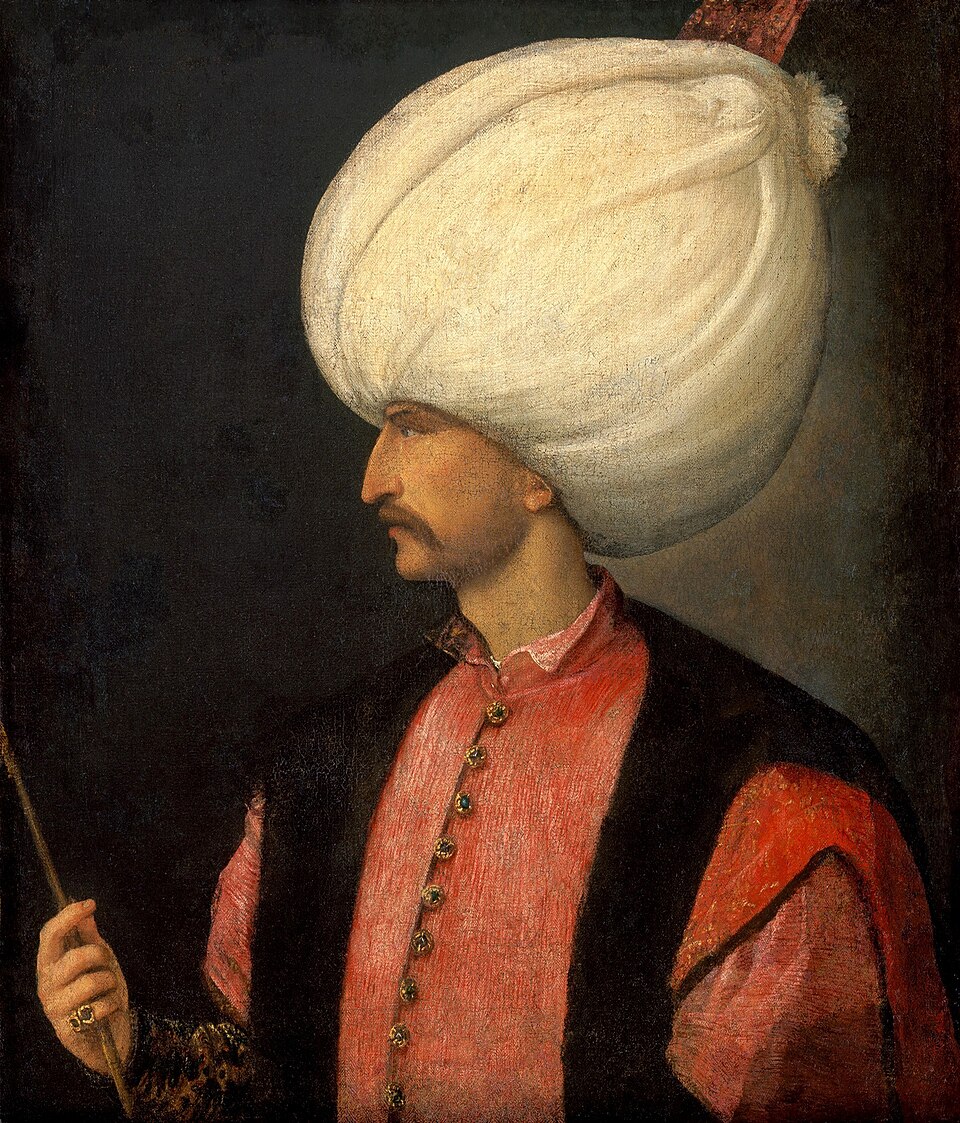
Suleiman in profile, attributed to the circle of Titian
A 1530s painted portrait of Suleiman in the Kunsthistorisches Museum, Vienna, attributed to the circle of Titian. This attribution does not establish that Titian painted it himself or that the sultan sat for the painter.
- Creator
- Attributed to the circle of Titian
- Collection / image provider
- Kunsthistorisches Museum, Vienna, GG 2429 · Wikimedia Commons
- Source and reuse
- Source record · Public Domain Mark 1.0
The source identifies this image as public domain. Consult its item-specific rights record and terms below; CivAtlas does not claim new copyright or grant additional rights in this image.
Public domain, as identified in the source record. Source credit: Attributed to the circle of Titian. Reuse terms: Public Domain Mark 1.0.