Napoleon Bonaparte
Revolution, imperial power and the cost of conquest.
Public life
On this page
Life overview
Born in Corsica, Napoleon became a French officer, seized political power and crowned himself emperor. These five stages connect his origins, the coup, imperial government, defeat and exile. They are selected turning points, not a map of every campaign.
Places and turning points
Dashed lines show the order of selected places, not an exact travel route.
15 August 1769
Corsican beginnings
Ajaccio, Corsica City-level representative point
Napoleon was born in Ajaccio shortly after Corsica came under French control. His family belonged to the island’s minor nobility. Recognition of that status helped him obtain a military education in mainland France, linking a Corsican childhood to a career within the French state.
City-level representative point; it does not locate a particular room, institution or travel route.
Representative coordinates · 41.919°, 8.738°
9–10 November 1799
The coup at Saint-Cloud
Saint-Cloud, near Paris City-level representative point
The coup began on 18 Brumaire in Paris and reached its decisive confrontation at Saint-Cloud the next day. Soldiers expelled deputies from the assembly. The Directory fell and the Consulate replaced it, enabling Bonaparte to concentrate executive power as First Consul.
City-level representative point; it does not locate a particular room, institution or travel route.
Representative coordinates · 48.847°, 2.219°
1804
A code and an imperial crown
Paris City-level representative point
The Civil Code was promulgated in March, and Napoleon’s coronation took place at Notre-Dame in December. Codification consolidated property rights and legal uniformity, while the imperial settlement concentrated authority in a hereditary ruler. Civil institutions and personal rule developed together rather than in separate eras.
City-level representative point; it does not locate a particular room, institution or travel route.
Representative coordinates · 48.8566°, 2.3522°
18 June 1815
Defeat at Waterloo
Waterloo, present-day Belgium City-level representative point
After returning from Elba, Napoleon attempted to rebuild his rule during the Hundred Days. At Waterloo his army was defeated by the forces led by Wellington and Blücher. A second abdication followed. This point marks the campaign’s decisive defeat, not the precise position of his battlefield headquarters.
City-level representative point; it does not locate a particular room, institution or travel route.
Representative coordinates · 50.714°, 4.399°
1815–1821
Exile on Saint Helena
Longwood, Saint Helena Representative area
British custody took Napoleon to the remote South Atlantic island of Saint Helena. He spent his last years at Longwood, where he died on 5 May 1821. Exile removed him from European political power, while recollections and later publications helped shape competing accounts of his rule.
Representative point for the Longwood settlement area; not the surveyed position of a room or a reconstructed sea route.
Representative coordinates · -15.946°, -5.676°
Legacy and context
His government consolidated legal and administrative reforms while restricting political opposition. Conquest spread both institutions and suffering. His colonial policy also maintained or restored slavery in several colonies; legal reform did not mean equal freedom for everyone.
Bibliography
- Fondation Napoléon: Timeline—Consulate and First French Empire
- Fondation Napoléon: Domaine national de Saint-Cloud
- Fondation Napoléon: Why did Napoleon bring back slavery?
References support specific dates and context. Bibliographies are displayed as text.
Image and source
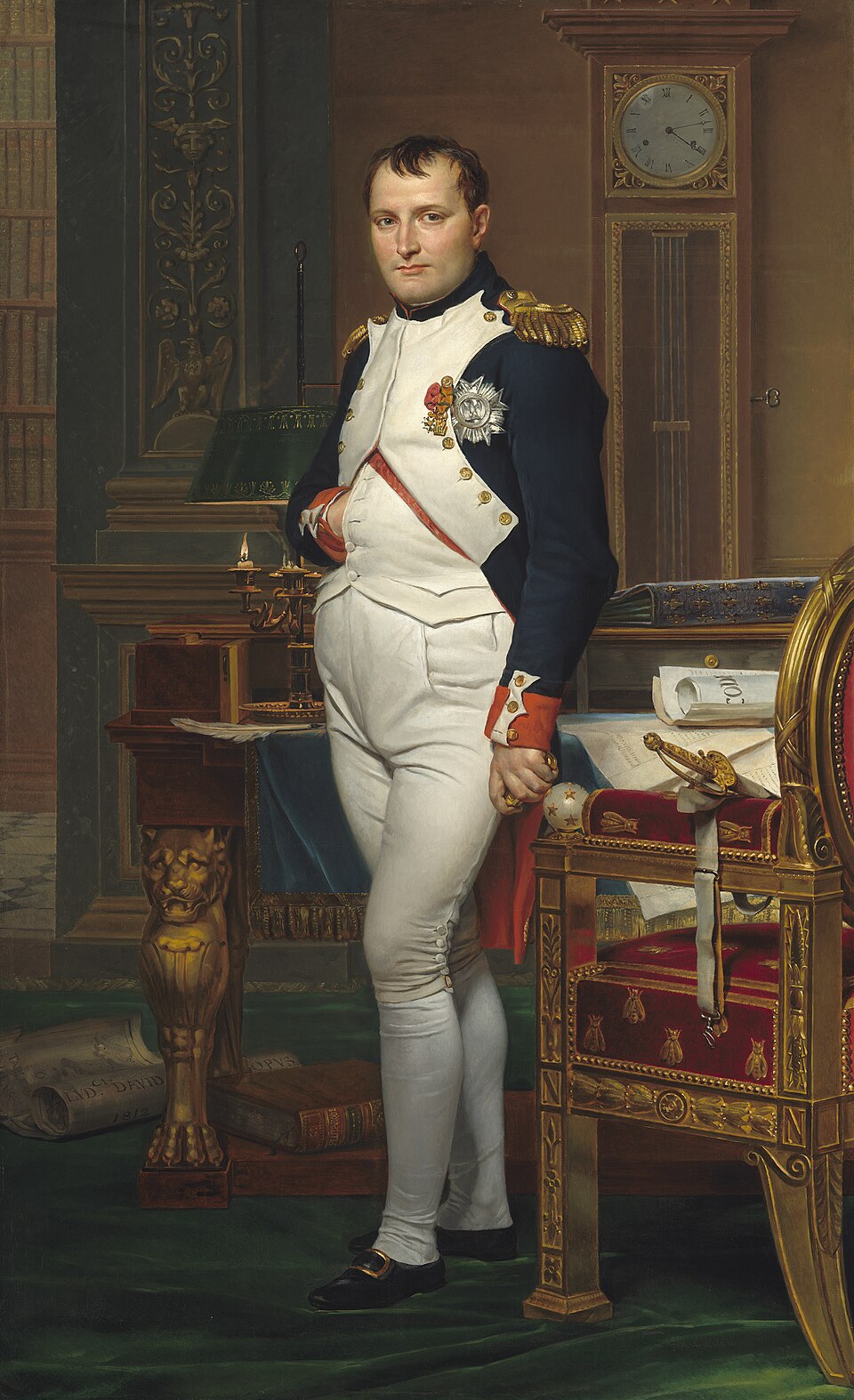
Napoleon in his study, painted by Jacques-Louis David in 1812
Jacques-Louis David’s The Emperor Napoleon in His Study at the Tuileries, 1812, National Gallery of Art, Washington. This carefully arranged painted image presents imperial authority; it is not a candid record of Napoleon at work.
- Creator
- Jacques-Louis David
- Collection / image provider
- National Gallery of Art, Washington, Samuel H. Kress Collection, 1961.9.15 · Wikimedia Commons
- Source and reuse
- Source record · CC0 1.0 Universal
The source makes this image available under CC0 1.0. Consult the dedication and item-specific record below; CivAtlas adds no further restrictions.
CC0 1.0 public-domain dedication, as stated in the source record. Source credit: Jacques-Louis David. Reuse terms: CC0 1.0 Universal.