Isabella I of Castile
Castilian kingship, dynastic union and the costs of expansion
Public life
On this page
Life overview
Isabella ruled Castile from 1474 and governed alongside Ferdinand of Aragon. Their marriage linked crowns without immediately merging their institutions. Five places connect the succession struggle, conquest, religious coercion and Atlantic sponsorship.
Places and turning points
Dashed lines show the order of selected places, not an exact travel route.
1469
A marriage connecting two dynasties
Valladolid City-level representative point
Isabella married Ferdinand of Aragon at Valladolid. The alliance later joined their rule over Castile and Aragon, but each crown retained its own institutions. The wedding did not create a single modern Spanish state; Isabella’s claim to the Castilian throne still faced competing supporters and armed conflict.
City-level marker; no individual building or exact route is asserted.
Representative coordinates · 41.6523°, -4.7245°
1474
Claiming the Castilian crown
Segovia City-level representative point
After Henry IV died, Isabella was proclaimed queen of Castile at Segovia in December. Recognition was contested by supporters of Juana, and a succession war followed. Her later consolidation of authority depended on political agreements and military struggle, rather than an uncontested transfer of a unified Spanish crown.
City-level marker; no individual building or exact route is asserted.
Representative coordinates · 40.9429°, -4.1088°
1492
Conquest and religious exclusion
Granada City-level representative point
The surrender of Granada ended Nasrid rule after years of warfare by Isabella and Ferdinand. In the same year their expulsion decree forced Jews who refused conversion to leave their realms. These were distinct decisions with severe consequences; the conquest did not mean that Muslim communities immediately disappeared.
City-level marker; no individual building or exact route is asserted.
Representative coordinates · 37.1773°, -3.5986°
1492
Setting the terms of Columbus’s voyage
Santa Fe City-level representative point
At Santa Fe, Isabella and Ferdinand authorized the terms of Columbus’s planned voyage across the Atlantic. The agreement promised offices and shares of proceeds under specified conditions. Royal sponsorship helped make the voyage possible; the resulting sustained contacts also opened an era of conquest and colonization in already inhabited lands.
City-level marker; no individual building or exact route is asserted.
Representative coordinates · 37.189°, -3.718°
1504
A final testament and a contested succession
Medina del Campo City-level representative point
Isabella made her testament at Medina del Campo and died there later in 1504. The Castilian crown passed to her daughter Juana, while authority remained disputed among family members. The succession exposed the limits of the dynastic partnership: marriage had linked monarchs without erasing the separate political identity of each crown.
City-level marker; no individual building or exact route is asserted.
Representative coordinates · 41.3128°, -4.914°
Legacy and context
Her reign strengthened royal authority and helped establish sustained Atlantic connections. Warfare, the persecution and expulsion of religious minorities, and overseas colonization imposed lasting human costs.
Bibliography
- The Met: Iberian Peninsula, 1400–1600
- City of Segovia: proclamation of Isabella (Spanish)
- Spanish Ministry of Culture: Santa Fe Capitulations (Spanish)
- UNESCO Memory of the World: Santa Fe Capitulations
- Spain official tourism: Medina del Campo and Isabella’s testament palace
References support specific dates and context. Bibliographies are displayed as text.
Image and source
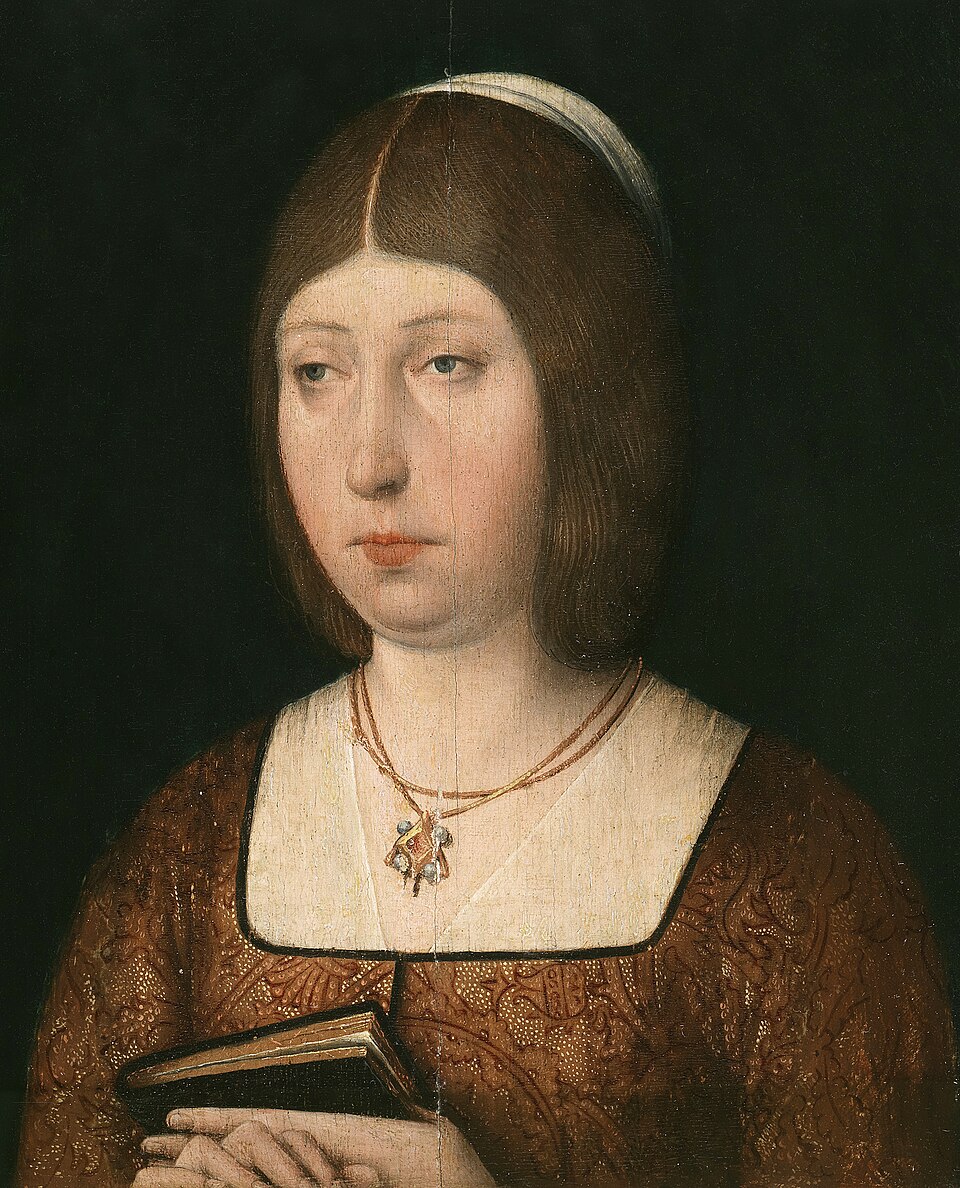
Isabella I of Castile, anonymous portrait, c. 1490
An anonymous oil-on-panel portrait, dated c. 1490, in the Museo del Prado. The artist is not securely named. Wikimedia Commons supplies the faithful reproduction as public domain; this is not an AI reconstruction.
- Creator
- Creator not named in the source record
- Collection / image provider
- Museo Nacional del Prado, Madrid; inventory P07656 · Wikimedia Commons
- Source and reuse
- Source record · Public Domain Mark 1.0 / PD-Art
The source identifies this image as public domain. Consult its item-specific rights record and terms below; CivAtlas does not claim new copyright or grant additional rights in this image.
Public domain, as identified in the source record. Source credit: Creator not named (anonymous painter, c. 1490); photographic reproduction credited by file metadata to Alberto Otero Herranz / Museo del Prado. Reuse terms: Public Domain Mark 1.0 / PD-Art.