Emperor Meiji
The imperial court and the remaking of the Japanese state
Public life
On this page
Life overview
Born Mutsuhito in Kyoto, Emperor Meiji reigned during the overthrow of the shogunate and the creation of new national institutions. His itinerary links the Kyoto court with Tokyo. Restoration leaders, officials and political movements shaped these changes alongside the emperor; the transformation was not one person’s work.
Places and turning points
Dashed lines show the order of selected places, not an exact travel route.
1852
Childhood in the Kyoto court world
Kyoto, Japan City-level representative point
Mutsuhito was born in Kyoto, the son of Emperor Komei and Nakayama Yoshiko, and spent his early childhood at the Nakayama residence. Kyoto was the home of the imperial court while the shogunate governed from Edo. His later title Meiji names an era and is also the posthumous name by which he is known.
City-level reference; the marker does not identify a particular room or building.
Representative coordinates · 35.0116°, 135.7681°
1867–1868; accession 1867, enthronement ceremony 1868
Accession during a political rupture
Kyoto, Japan City-level representative point
Mutsuhito succeeded Emperor Komei in 1867. During 1867–1868, political power shifted away from the Tokugawa shogunate toward a new government acting in the emperor’s name. Court figures and leaders from several domains drove the process, which also involved civil war. Accession in 1867 and the formal enthronement ceremony in 1868 were separate events.
City-level reference; the marker does not identify a particular room or building.
Representative coordinates · 35.0116°, 135.7681°
1868–1869
Repeated visits turn Tokyo into a political center
Tokyo (formerly Edo), Japan City-level representative point
Edo was renamed Tokyo in 1868, and the emperor visited that year before returning to Kyoto. He went to Tokyo again in 1869 as central government offices also moved there. The shift of residence and administration was a process, not a single unambiguous declaration transferring the capital. Kyoto retained important imperial ceremonial functions.
City-level reference; the marker does not identify a particular room or building.
Representative coordinates · 35.6762°, 139.6503°
1889
The Meiji Constitution is promulgated
Tokyo, Japan City-level representative point
The Constitution of the Empire of Japan was promulgated in 1889 after work led by Ito Hirobumi and other officials. It defined the emperor as sovereign while providing for an Imperial Diet and ministerial advice. Rights were bounded by law. Its text and the practical distribution of political power require separate attention; this was not today’s constitutional system.
City-level reference; the marker does not identify a particular room or building.
Representative coordinates · 35.6762°, 139.6503°
1912
Death and the making of later commemoration
Tokyo, Japan City-level representative point
Meiji died in Tokyo in 1912, and his successor’s reign took the era name Taisho. He was buried at Fushimi Momoyama in Kyoto. The Meiji Shrine in Tokyo was founded in 1920 to commemorate the emperor and his consort. Burial, death place and later memorial shrine are distinct locations and moments, not interchangeable stops in his living itinerary.
City-level reference; the marker does not identify a particular room or building.
Representative coordinates · 35.6762°, 139.6503°
Legacy and context
His reign combined institutional and industrial change with an imperial system of sovereignty and overseas expansion, including Japan’s annexation of Korea in 1910. Constitutional language and practical decisions should be read separately: ministers, elder statesmen and other institutions exercised substantial power. This itinerary is a selection, not a complete account of the era.
Bibliography
- Japan Tourism Agency: Site of the Nakayama Residence (English)
- Imperial Household Agency: chronology since1867 (Japanese)
- National Archives of Japan: second Tokyo visit1869 (Japanese)
- National Diet Library: Constitution of the Empire of Japan (English translation)
- National Diet Library: Initial Steps toward a Constitutional State (English)
References support specific dates and context. Bibliographies are displayed as text.
Image and source
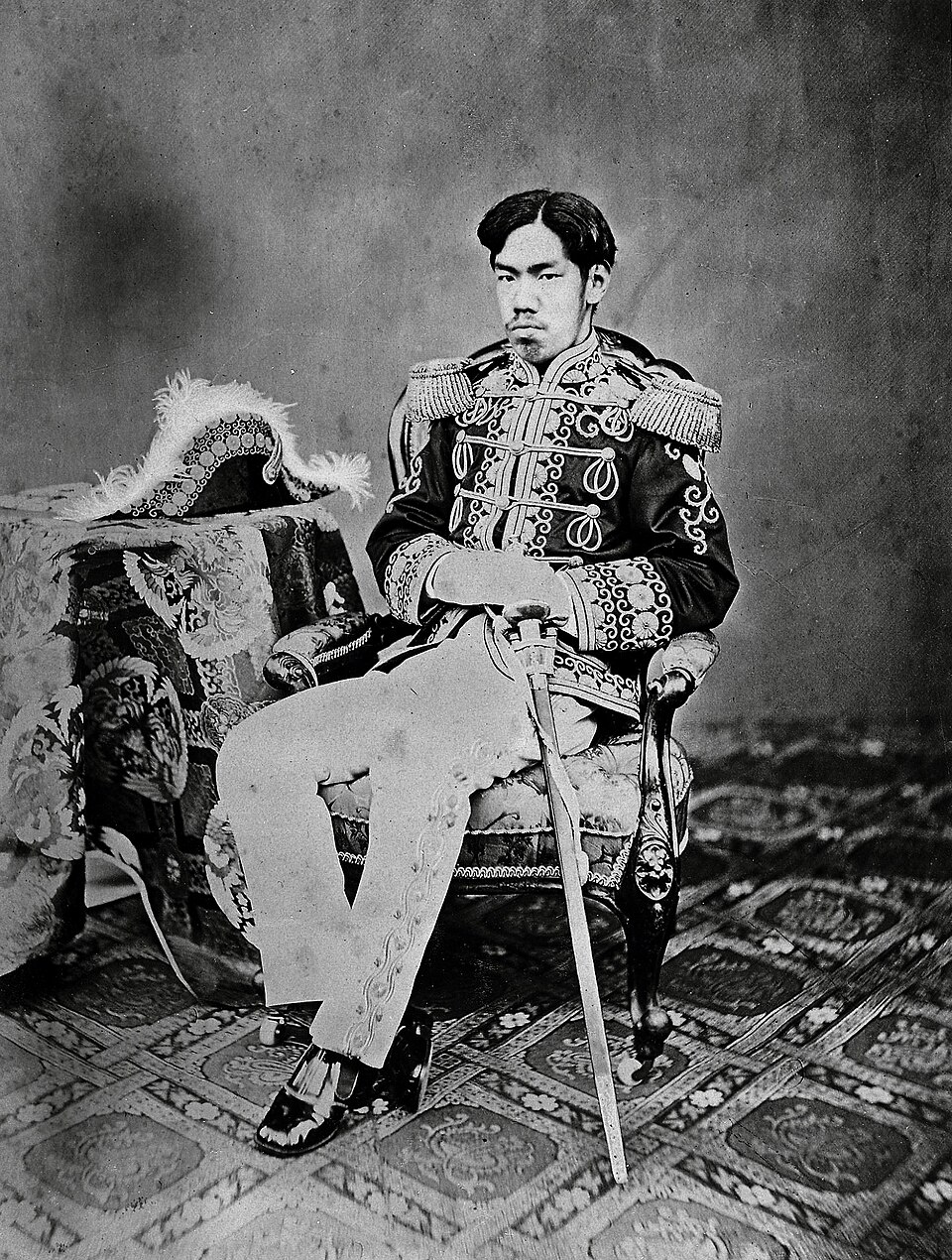
Emperor Meiji, photographed by Uchida Kuichi in 1873
An 1873 photograph of Meiji in military dress by Uchida Kuichi. This is a historical photograph, distinct from the widely reproduced later drawn imperial portrait. The Wikimedia Commons record also identifies publication in Meiji Tenno Gyoden,1912.
- Creator
- Uchida Kuichi (1844–1875)
- Collection / image provider
- Historical print; Commons source record cites The Cleveland Museum of Art · Wikimedia Commons
- Source and reuse
- Source record · Public Domain Mark 1.0
The source identifies this image as public domain. Consult its item-specific rights record and terms below; CivAtlas does not claim new copyright or grant additional rights in this image.
Public domain, as identified in the source record. Source credit: Uchida Kuichi (1844–1875). Reuse terms: Public Domain Mark 1.0.