Elizabeth I
Succession, religious government and an island kingdom at war.
Public life
On this page
Life overview
Elizabeth’s path from a royal prisoner to England’s queen remained geographically concentrated. These five stages focus on London, Hatfield, Tilbury and Richmond. The map follows her documented presence, not naval battles she did not personally fight.
Places and turning points
Dashed lines show the order of selected places, not an exact travel route.
1554
A royal prisoner
London City-level representative point
During Mary I’s reign, Elizabeth was imprisoned in the Tower after Wyatt’s rebellion raised suspicions about her involvement. She survived the crisis and was later moved from the Tower. Her future accession was far from assured: dynastic succession and religious division could place even a king’s daughter in danger.
City-level representative point; it does not locate a particular room, institution or travel route.
Representative coordinates · 51.507°, -0.128°
17 November 1558
News of the crown at Hatfield
Hatfield City-level representative point
While living at the old palace at Hatfield, Elizabeth learned that Mary I had died and that she had become queen. The familiar story places the news beneath an oak, but that setting is traditional. The secure point is Hatfield, followed by preparations for a government facing religious and diplomatic uncertainty.
City-level representative point; it does not locate a particular room, institution or travel route.
Representative coordinates · 51.764°, -0.225°
1559
Coronation and religious government
London City-level representative point
Elizabeth’s coronation at Westminster Abbey on 15 January presented her claim publicly. Later that year the religious settlement reasserted royal authority over the English church and a common form of worship. This institutional compromise did not end religious disagreement; compliance was backed by government power, not simply voluntary consensus.
City-level representative point; it does not locate a particular room, institution or travel route.
Representative coordinates · 51.507°, -0.128°
1588
Visiting the army at Tilbury
West Tilbury area City-level representative point
During the Spanish Armada crisis, Elizabeth visited the army assembled near West Tilbury to resist a landing. Her presence became central to later images of the reign. She was addressing a land force, not commanding the naval battle; the surviving fort’s main buildings also belong to a later century.
City-level representative point; it does not locate a particular room, institution or travel route.
Representative coordinates · 51.463°, 0.36°
24 March 1603 (Julian)
The end of Tudor rule
Richmond City-level representative point
Elizabeth died at Richmond Palace without a direct heir. James VI of Scotland succeeded as James I of England, bringing the crowns under one monarch while the kingdoms remained legally distinct. Her final years had included economic hardship and expensive war, complicating the polished image of an uninterrupted golden age.
City-level representative point; it does not locate a particular room, institution or travel route.
Representative coordinates · 51.461°, -0.304°
Legacy and context
Her reign strengthened a Protestant state and supported a flourishing court culture, but also brought religious coercion, costly wars and colonial expansion. The celebrated image of a golden age was cultivated by the monarchy and should be read alongside those experiences.
Bibliography
- The Royal Household: Elizabeth I, 1558–1603
- Historic Royal Palaces: Elizabeth I, the Last Tudor
- Historic Royal Palaces: The Elizabethan era—a golden age?
- Hatfield Park: History and Heritage
- English Heritage: History of Tilbury Fort
References support specific dates and context. Bibliographies are displayed as text.
Image and source
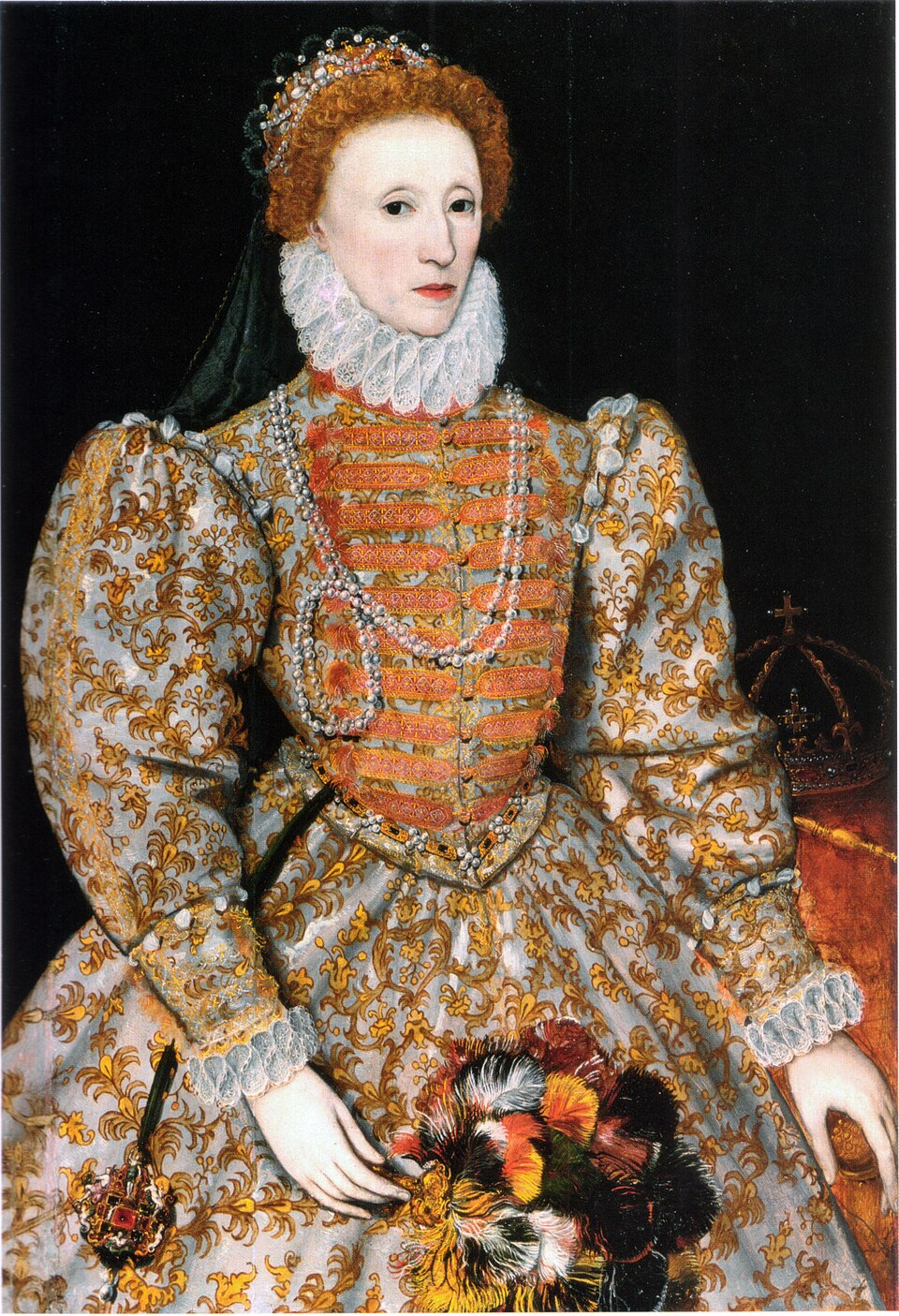
Elizabeth I: the Darnley portrait, c. 1575
The Darnley portrait of Elizabeth I, around 1575, held by London’s National Portrait Gallery. The artist is unknown, sometimes associated with Federico Zuccaro; the attribution is not certain. This reproduction is supplied through Wikimedia Commons.
- Creator
- Creator not named in the source record
- Collection / image provider
- National Portrait Gallery, London, NPG 2082 · Wikimedia Commons
- Source and reuse
- Source record · Public Domain Mark 1.0
The source identifies this image as public domain. Consult its item-specific rights record and terms below; CivAtlas does not claim new copyright or grant additional rights in this image.
Public domain, as identified in the source record. Source credit: Creator not named with certainty; perhaps Federico Zuccaro. Reuse terms: Public Domain Mark 1.0.