Deng Xiaoping
Overseas study and the reform era
Public life
On this page
Life overview
Deng Xiaoping was a Chinese political leader associated with the reform and opening programme begun in the late 1970s. These stages connect his Sichuan origins, work-study experience in France, central leadership in Beijing and the southern visits of 1992.
Places and turning points
Dashed lines show the order of selected places, not an exact travel route.
22 August 1904
Birth in Guang’an
Guang’an, Sichuan City-level representative point
Deng was born in Paifang village in Guang’an, Sichuan. His early schooling preceded a move to Chongqing for preparation for work-study abroad. The city-level marker gives regional orientation and does not identify a particular room in the later memorial complex or imply that his entire education took place in one village.
City-level reference; the marker does not identify a particular room or building.
Representative coordinates · 30.456°, 106.633°
1920
Early study in France
Bayeux, Normandy City-level representative point
Deng arrived in France in October 1920 and soon entered a boys’ secondary school in Bayeux. This was an early phase of a longer work-study experience that also involved employment and political connections elsewhere. Bayeux is the documented school city; it is not substituted for his whole French itinerary.
City-level reference; the marker does not identify a particular room or building.
Representative coordinates · 49.2765°, -0.7025°
December 1978
The reform-era policy turn
Beijing City-level representative point
At the Third Plenum of the Eleventh Central Committee, the party shifted its working focus toward economic development and reform. Deng played a central role in the policy turn and its preparation. The meeting is a chronological anchor for reforms that developed through later decisions, local experiments and changing economic institutions.
City-level reference; the marker does not identify a particular room or building.
Representative coordinates · 39.9042°, 116.4074°
1992
Southern visits and economic reform
Shenzhen; one stop among several southern visits City-level representative point
Deng visited Wuchang, Shenzhen, Zhuhai and Shanghai, discussing reform and development during a period of policy debate. The talks helped reinforce the direction of market-oriented economic change. Shenzhen is one documented stop, not the location of every discussion; the line from Beijing does not reconstruct the tour’s actual transport sequence.
City-level reference; the marker does not identify a particular room or building.
Representative coordinates · 22.5431°, 114.0579°
19 February 1997
Death before the Hong Kong handover
Beijing City-level representative point
Deng died in Beijing on 19 February 1997. The Hong Kong handover took place later that year, so his association with its negotiated framework must be separated from attendance at the ceremony. This endpoint records his death while allowing the related event to explain an important later development in its own chronology.
City-level reference; the marker does not identify a particular room or building.
Representative coordinates · 39.9042°, 116.4074°
Legacy and context
His influence on economic policy extended beyond particular offices he held. The itinerary separates his documented activities from later events, including the Hong Kong handover, which took place after his death.
Bibliography
- 人民网:邓小平生平简介 (Chinese source)
- 共产党员网:邓小平生平年表·1904—1920 (Chinese source)
References support specific dates and context. Bibliographies are displayed as text.
Image and source
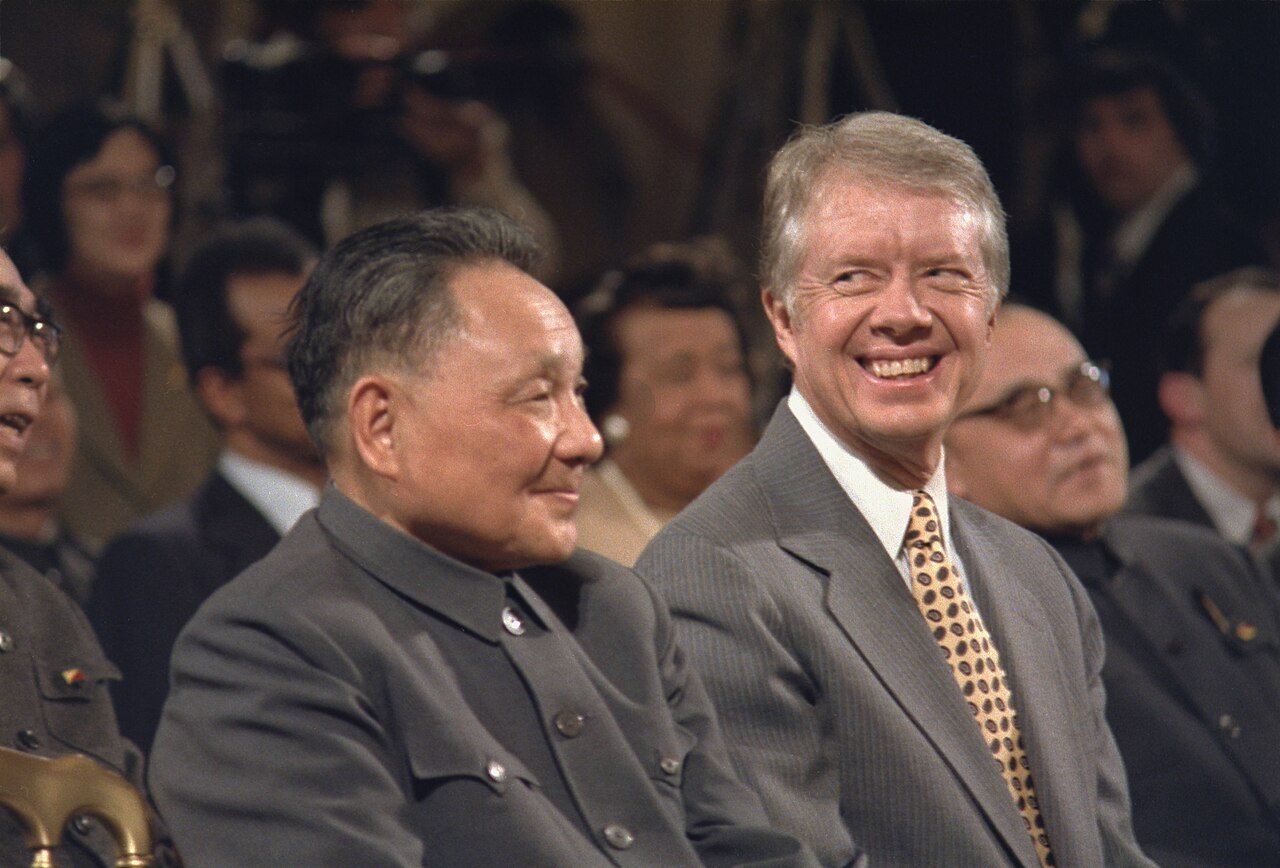
Deng Xiaoping and Jimmy Carter sign agreements
Deng Xiaoping and Jimmy Carter at a signing ceremony on 31 January 1979. The photograph records China’s diplomatic opening after the 1978 policy turn; it is not a photograph of the Third Plenum.
- Creator
- Karl H. Schumacher / White House
- Collection / image provider
- U.S. National Archives, Jimmy Carter Presidential Library · Wikimedia Commons
- Source and reuse
- Source record · Public domain — U.S. federal government work
The source identifies this image as public domain. Consult its item-specific rights record and terms below; CivAtlas does not claim new copyright or grant additional rights in this image.
Public domain, as identified in the source record. Source credit: Karl H. Schumacher / White House. Reuse terms: Public domain — U.S. federal government work.