Alexander the Great
Macedonian kingship, conquest and a contested succession
Public life
On this page
Life overview
Alexander inherited a Macedonian kingdom reshaped by Philip II and led campaigns through the Persian Empire. This life follows five documented centres rather than drawing a continuous marching route.
Places and turning points
Dashed lines show the order of selected places, not an exact travel route.
356 BCE
A prince in the Macedonian court
Pella City-level representative point
Alexander was born into the Argead royal family and grew up at Pella. Philip II’s military and political reforms supplied the kingdom he later inherited. Court education and competition for succession shaped his early world; the map marks the ancient city rather than an identified room of birth.
City-level marker; no individual building is asserted.
Representative coordinates · 40.755°, 22.521°
336 BCE
A succession after assassination
Aigai City-level representative point
Philip II was assassinated at Aigai in 336 BCE, and Alexander succeeded him. Inheriting a powerful army did not guarantee secure rule: he had to assert authority within Macedonia and among allied Greek states. This transition explains the political foundations of the campaigns that followed.
City-level marker; no individual building is asserted.
Representative coordinates · 40.487°, 22.322°
334 BCE
Crossing into Persian territory
Troy region Representative area
Alexander crossed into Asia Minor and visited Troy as his campaign against the Persian Empire began. His army’s subsequent victory at the Granicus opened further advances. The Troy marker represents a documented early stop, not the crossing point or the battlefield, and the connecting line is chronological only.
Regional reference point, not a verified camp or exact route.
Representative coordinates · 39.957°, 26.239°
331 BCE
Founding a Mediterranean city
Alexandria City-level representative point
After occupying Egypt, Alexander founded Alexandria on the Mediterranean coast. Its harbour and location linked Egypt with wider trading networks. The major library and royal institutions associated with the city developed under the Ptolemies after his death; they should not all be credited to his own brief stay.
City-level marker; no individual building is asserted.
Representative coordinates · 31.2°, 29.918°
323 BCE
Death without a secure succession
Babylon City-level representative point
Alexander died in Babylon in 323 BCE. No adult successor could command universal acceptance, and struggles among his generals gradually divided the empire. The resulting kingdoms retained and transformed many institutions and cultural connections created during conquest, while their wars reshaped the lives of conquered populations.
City-level marker; no individual building is asserted.
Representative coordinates · 32.54°, 44.42°
Legacy and context
His conquests accelerated movement and cultural exchange while causing destruction and coercion. The Hellenistic kingdoms developed through his successors’ struggles, not a stable empire that survived him.
Bibliography
- The Met: Alexander and the Hellenistic kingdoms
- Greek Ministry of Culture: Alexander virtual museum
References support specific dates and context. Bibliographies are displayed as text.
Image and source
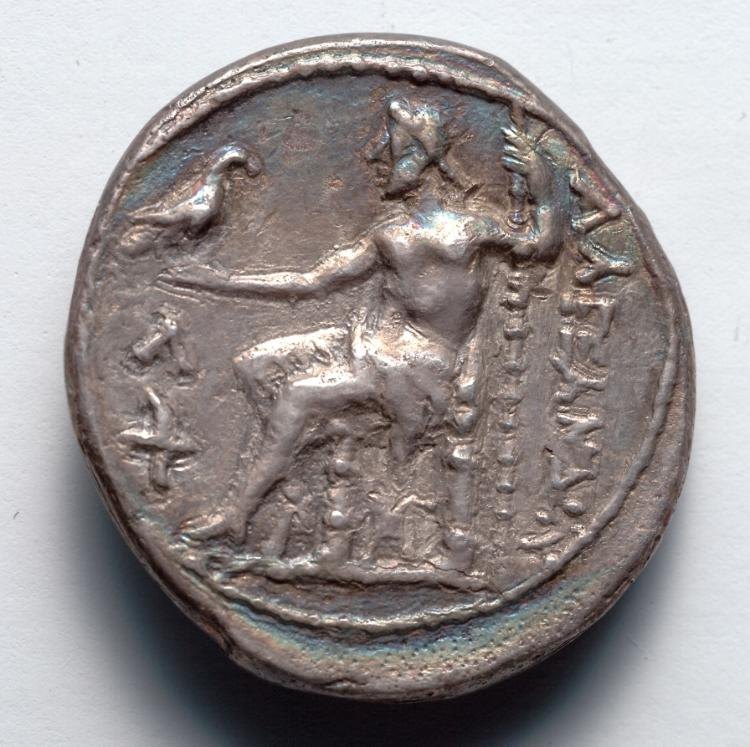
Coin of Alexander III’s reign
Silver tetradrachm minted at Amphipolis during Alexander III’s reign, 336–323 BCE. The reverse shows Zeus; the coin is an original object of the era, not a portrait of Alexander’s expedition.
- Creator
- Greek, Macedonian mint at Amphipolis
- Collection / image provider
- Cleveland Museum of Art
- Source and reuse
- Source record · CC0 1.0 Universal
The source makes this image available under CC0 1.0. Consult the dedication and item-specific record below; CivAtlas adds no further restrictions.
CC0 1.0 public-domain dedication, as stated in the source record. Source credit: Greek, Macedonian mint at Amphipolis. Reuse terms: CC0 1.0 Universal.