Akbar
Building Mughal authority through armies, administration and court culture
Public life
On this page
Life overview
Akbar became emperor in 1556 and extended Mughal rule through conquest and political accommodation. Capitals, forts and court workshops show how military authority, revenue and cultural patronage worked together.
Places and turning points
Dashed lines show the order of selected places, not an exact travel route.
1542
Born away from a secure throne
Umerkot City-level representative point
Akbar was born at Umerkot while his father Humayun’s position was insecure. His childhood therefore preceded the later consolidation of Mughal power. The surviving memorial was erected in 1898; it is evidence of later commemoration, not the original building in which the future emperor was born.
City-level marker; no individual building is asserted.
Representative coordinates · 25.36°, 69.74°
1556
A young emperor in Punjab
Kalanaur City-level representative point
Akbar was proclaimed emperor at Kalanaur after Humayun’s death. His youth made the support of senior commanders, especially Bairam Khan, crucial to the new reign. The ceremony established a claim to sovereignty; maintaining it required armies and negotiations rather than the coronation alone. The map uses the town, not a precisely surveyed platform.
City-level marker; no individual building is asserted.
Representative coordinates · 32.012°, 75.153°
c. 1565 onward
Fortifying an imperial centre
Agra City-level representative point
Akbar began rebuilding Agra’s fort around 1565. Fortification and palace space supported a court that coordinated armies, revenue and appointments across an expanding state. Later rulers altered much of the complex, especially under Shah Jahan, so the buildings visible today cannot all be treated as surviving works of Akbar’s reign.
City-level marker; no individual building is asserted.
Representative coordinates · 27.177°, 78.008°
1571–1585
A planned capital and a debating court
Fatehpur Sikri City-level representative point
Akbar developed Fatehpur Sikri as an imperial capital, with palace buildings combining regional and Central Asian traditions. Courtly debate brought different religious specialists into conversation, while artists of varied backgrounds worked on manuscripts. These activities expressed royal patronage and authority; they did not establish equal citizenship in the modern sense.
City-level marker; no individual building is asserted.
Representative coordinates · 27.094°, 77.667°
From 1585 · broad transition
A court that changed its centre
Lahore City-level representative point
Akbar adopted Lahore as a principal residence in the mid-1580s, shifting the court’s political and artistic centre. Imperial administration did not depend on one permanent capital. Workshops and officials moved with the court, while regional campaigns and connections continued to shape decisions. The date marks a broad transition rather than every movement in a single year.
City-level marker; no individual building is asserted.
Representative coordinates · 31.55°, 74.34°
Legacy and context
His reign consolidated institutions and brought diverse elites into imperial service. Courtly religious debate and artistic collaboration should be understood alongside unequal rule and the violence of expansion.
Bibliography
- The Met: The Art of the Mughals before 1600
- Pakistan Department of Archaeology: Akbar’s birthplace memorial
- District Gurdaspur: Kalanaur
- Government of Uttar Pradesh: Agra Fort
References support specific dates and context. Bibliographies are displayed as text.
Image and source
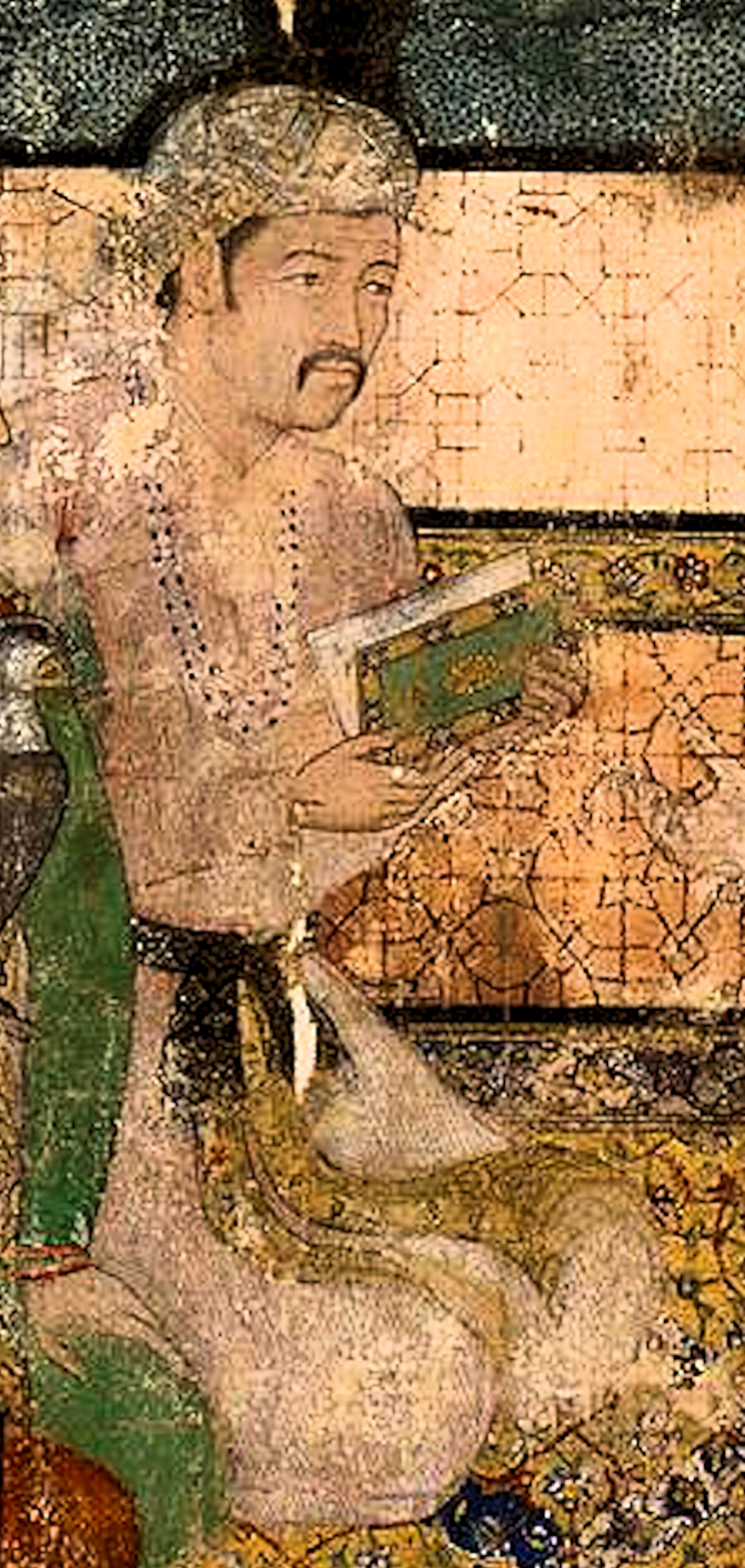
Seated portrait of Akbar, provider dated 1605
A seated painted figure of Akbar extracted by the provider from a Mughal dynastic group painting. The selected record dates this detail to 1605 but does not name its artist; it is not a photograph or a verified record of a particular sitting.
- Creator
- Creator not named in the source record
- Collection / image provider
- Mughal dynastic group painting; selected extract via Wikimedia Commons · Wikimedia Commons
- Source and reuse
- Source record · Public Domain Mark 1.0
The source identifies this image as public domain. Consult its item-specific rights record and terms below; CivAtlas does not claim new copyright or grant additional rights in this image.
Public domain, as identified in the source record. Source credit: Creator not named in selected record (Mughal painting). Reuse terms: Public Domain Mark 1.0.