Abraham Lincoln
Preserving the Union and confronting slavery during civil war.
Public life
On this page
Life overview
Lincoln built a legal and political career in Illinois before becoming the sixteenth US president. These stages follow Springfield, wartime Washington and Gettysburg, distinguishing a changing emancipation policy from the later constitutional abolition of slavery.
Places and turning points
Dashed lines show the order of selected places, not an exact travel route.
1837
A lawyer in Springfield
Springfield, Illinois City-level representative point
Lincoln moved to Springfield in April and began practising law with John T. Stuart. Legal work and service in the Illinois legislature developed together. His later circuit practice carried him through surrounding counties, but this city point represents his professional base rather than every courthouse he visited.
City-level representative point; it does not locate a particular room, institution or travel route.
Representative coordinates · 39.798°, -89.644°
4 March 1861
The presidency in a divided Union
Washington, DC City-level representative point
Lincoln took office after several southern states had announced secession. Fighting at Fort Sumter in April turned the crisis into civil war. His administration mobilised troops and initially made preservation of the Union its central military objective; emancipation policy developed during the conflict rather than arriving fully formed.
City-level representative point; it does not locate a particular room, institution or travel route.
Representative coordinates · 38.907°, -77.037°
1 January 1863
A wartime emancipation measure
Washington, DC City-level representative point
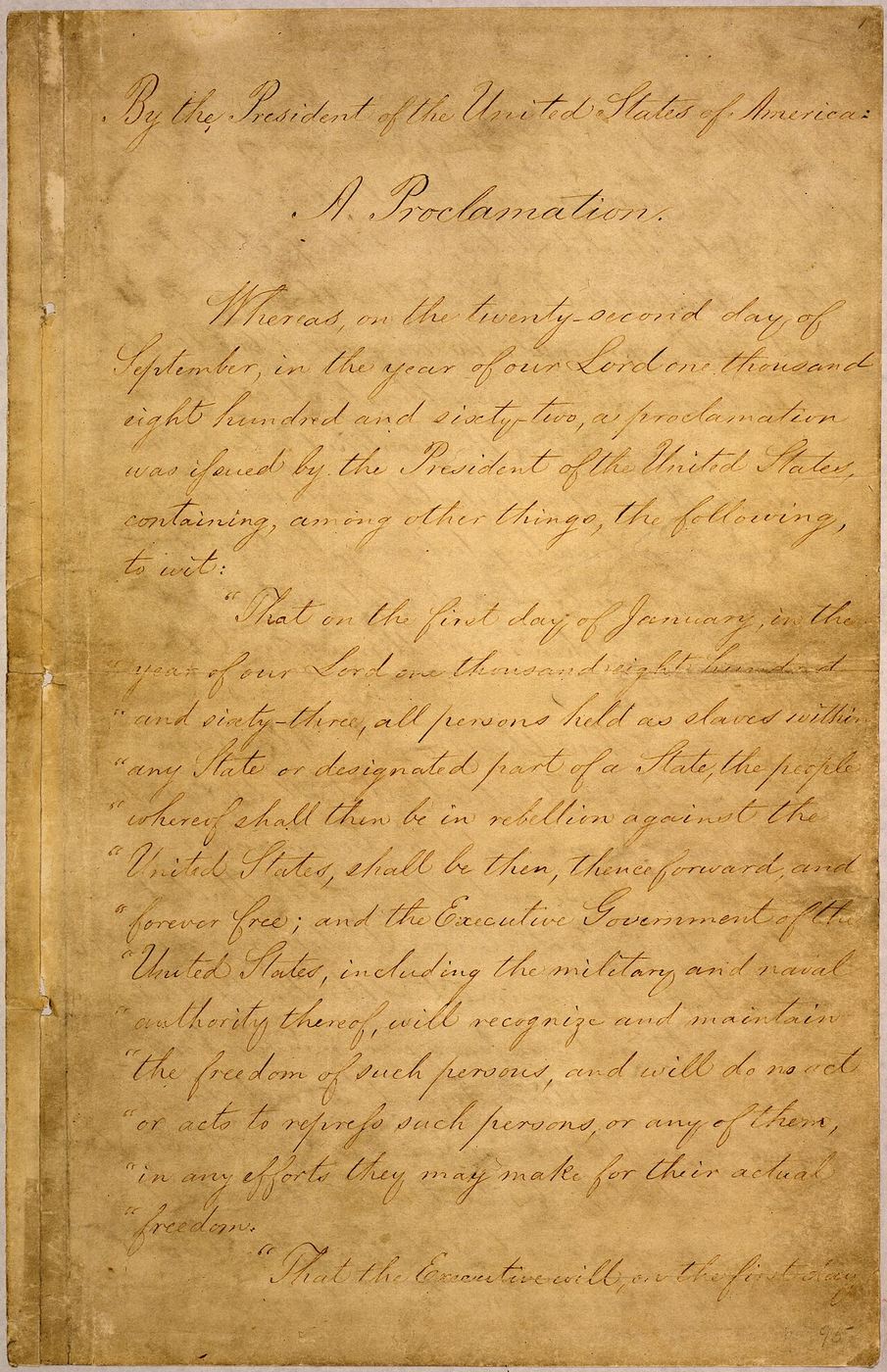
Lincoln issued the final Emancipation Proclamation, declaring freedom for enslaved people in specified areas in rebellion. It excluded loyal slaveholding border states and other exempted places. The measure changed the Union’s war aims and authorised Black military service, but freedom still depended on people’s actions and Union control.
City-level representative point; it does not locate a particular room, institution or travel route.
Representative coordinates · 38.907°, -77.037°
19 November 1863
Remembering the war at Gettysburg
Gettysburg, Pennsylvania City-level representative point
Lincoln spoke at the dedication of a soldiers’ cemetery several months after the battle of Gettysburg. He connected the Union’s survival with political equality and representative government. The visit was a commemorative and political occasion: the map does not imply that he commanded troops at the July battle.
City-level representative point; it does not locate a particular room, institution or travel route.
Representative coordinates · 39.831°, -77.231°
14–15 April 1865
Assassination before reconstruction
Washington, DC City-level representative point
Lincoln was shot at Ford’s Theatre on 14 April and died the next morning across the street at the Petersen boarding house. Congress had already passed the Thirteenth Amendment, but state ratification came in December. His death left the work of reconstruction and securing freedom to others.
City-level representative point; it does not locate a particular room, institution or travel route.
Representative coordinates · 38.907°, -77.037°
Legacy and context
Lincoln’s presidency helped preserve the Union and advance emancipation. Enslaved people, Black soldiers, abolitionists and Congress also shaped that process. The Emancipation Proclamation had wartime geographic limits; nationwide constitutional abolition was ratified after his death.
Bibliography
- US National Park Service: Life of Lincoln
- US National Park Service: Lincoln Chronology
- US National Archives: Emancipation Proclamation
- US National Archives: 13th Amendment to the US Constitution
References support specific dates and context. Bibliographies are displayed as text.
Image and source
The Emancipation Proclamation of 1863
The opening page of Abraham Lincoln’s Emancipation Proclamation of 1 January 1863. It refers back to the preliminary announcement of September 1862; constitutional abolition of slavery followed through the Thirteenth Amendment in 1865.
- Creator
- Abraham Lincoln
- Collection / image provider
- US National Archives · Wikimedia Commons
- Source and reuse
- Source record · Public domain
The source identifies this image as public domain. Consult its item-specific rights record and terms below; CivAtlas does not claim new copyright or grant additional rights in this image.
Public domain, as identified in the source record. Source credit: Abraham Lincoln. Reuse terms: Public domain.