
1989–1991 (proposal, implementation and dissemination) / Europe
The Web moves from a hypertext proposal to a working service
Berners-Lee and collaborators at CERN connected hypertext to the internet, developing browsers, servers and linked pages for sharing distributed information.
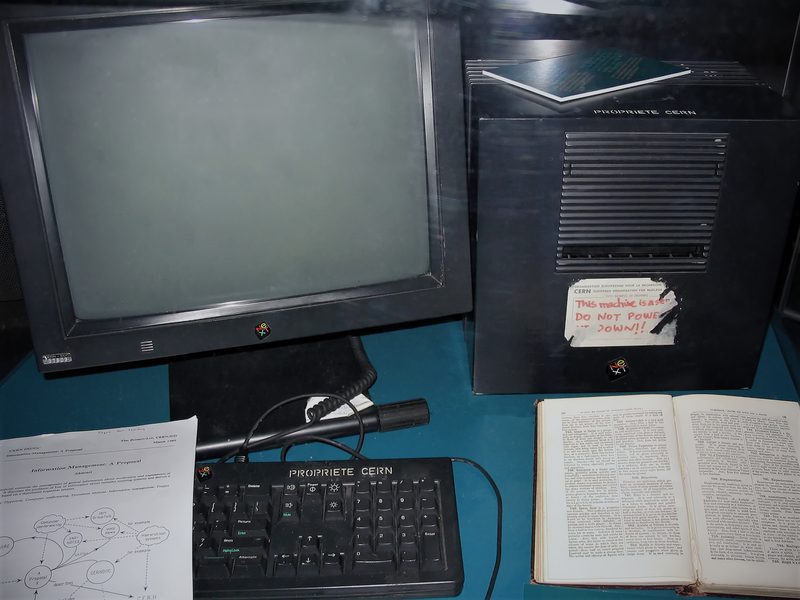
Image unavailable. The caption and source are still available.
The story
Berners-Lee proposed a distributed information system at CERN in 1989. In 1990 he advanced a formal proposal with Cailliau and implemented early browser, server and page software. During 1991, tools and announcements reached wider users; Pellow’s line-mode browser supported more kinds of computers. The Web was a service on the internet, not the internet itself. CERN’s 1993 release of the software was a separate step toward wider adoption.
Connections and context
Earlier networking research linked computers; the Web made navigating linked documents easier. Open protocols, browser development and participation across countries helped it expand beyond its original research setting.
Dates and precision
1989–1991 (proposal, implementation and dissemination) Ongoing process
The dates describe a span of activity; the timeline uses its starting point.
Representative map location
CERN near Geneva
The marker represents CERN’s Meyrin research setting for early Web development; later servers, dissemination and standards work spanned many countries.
Representative coordinates · 46.2336°, 6.0558°
A marker identifies one representative place, such as a manuscript collection, laboratory or observing site. It does not mean the work happened only there, or assign a shared discovery to one country.
Bibliography
- CERN: Web History
- Tim Berners-Lee: Information Management, A Proposal (1989)
- CERN: World Wide Web at 35
References are listed as plain bibliography titles. They support particular facts or context; a reference does not certify every interpretation in a story.