
9 October 1986 (Nature paper published) / Americas
A backpropagation paper shows multilayer networks learning internal representations
Rumelhart, Hinton and Williams showed how output errors could guide weight adjustments, allowing hidden units to learn features useful for a task.
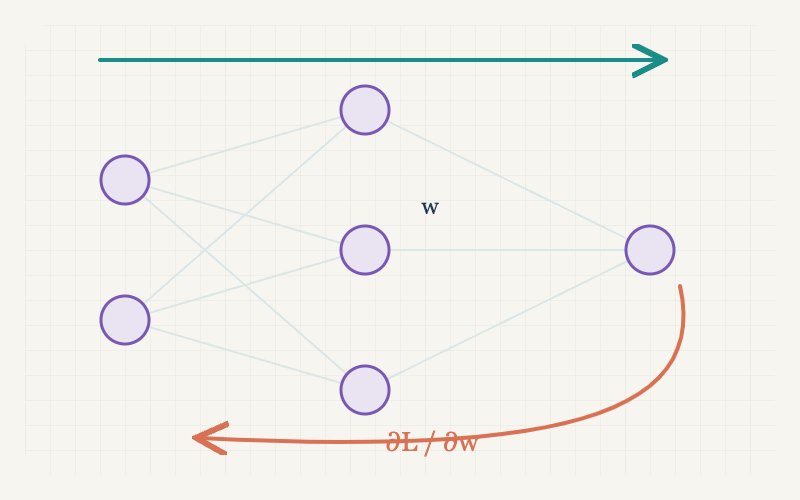
Image unavailable. The caption and source are still available.
The story
The 1986 Nature paper described propagating derivatives of an output error backward through a network, then adjusting connection weights toward a training target. It helped advance research on multilayer networks and learned representations. Reverse differentiation and related learning ideas had earlier histories; the three authors did not invent every ingredient in 1986. Nor did this mathematical model establish that biological brains learn by the same mechanism.
Connections and context
Backpropagation uses the chain rule of calculus, linking mathematical optimization to machine learning. Larger networks, datasets and computing hardware later expanded its applications and the need for careful evaluation.
Dates and precision
9 October 1986 (Nature paper published) Documented date
Positioned by the documented year, month or day. Missing precision is not inferred.
Representative map location
San Diego and a cross-university collaboration
The marker represents Rumelhart and Williams’s UC San Diego setting; Hinton’s affiliation on the paper was Carnegie Mellon University.
Representative coordinates · 32.8801°, -117.234°
A marker identifies one representative place, such as a manuscript collection, laboratory or observing site. It does not mean the work happened only there, or assign a shared discovery to one country.
Bibliography
- Rumelhart, Hinton and Williams: Learning representations by back-propagating errors
- Author-hosted copy of the 1986 Nature paper
References are listed as plain bibliography titles. They support particular facts or context; a reference does not certify every interpretation in a story.