
1969 (early nodes connected) / Americas
ARPANET links research computers through packet switching
ARPANET’s early nodes shared computing resources through packet switching, creating an important experimental foundation for later internetworking.
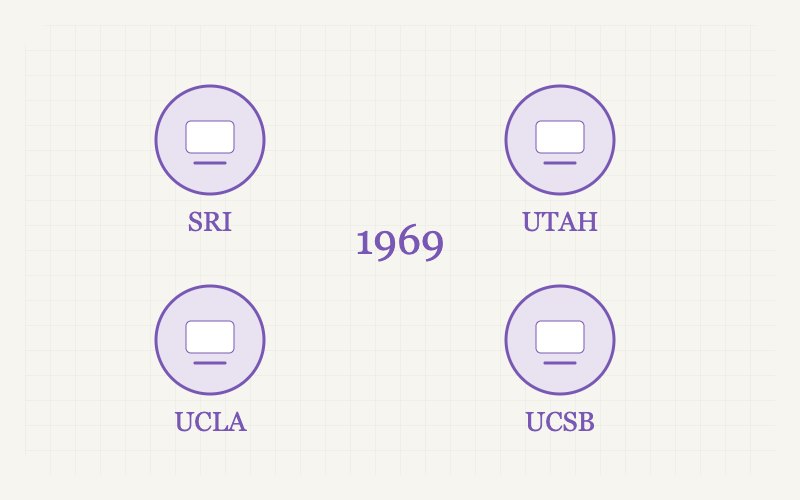
Image unavailable. The caption and source are still available.
The story
In 1969, ARPANET connected institutions including UCLA and the Stanford Research Institute, reaching four nodes by year’s end. An October remote-login attempt failed after only part of the message arrived, illustrating the practical work still required. ARPA, BBN and university teams contributed. This was not the completion of today’s internet in a single day: packet switching, internetwork protocols and the later Web were distinct developments.
Connections and context
Packets allowed devices to share communication links. Common protocols later connected different networks; the Web would organize linked documents on top of the internet rather than replace it.
Dates and precision
1969 (early nodes connected) Documented date
Positioned by the documented year, month or day. Missing precision is not inferred.
Representative map location
Los Angeles (UCLA node)
The marker identifies UCLA’s early node. Initial communication reached SRI; Santa Barbara and Utah were the other original nodes.
Representative coordinates · 34.0689°, -118.4438°
A marker identifies one representative place, such as a manuscript collection, laboratory or observing site. It does not mean the work happened only there, or assign a shared discovery to one country.
Bibliography
- DARPA: ARPANET
- Leonard Kleinrock, UCLA: An Early History of the Internet
References are listed as plain bibliography titles. They support particular facts or context; a reference does not certify every interpretation in a story.