
1800 (report of the pile) / Europe
Volta’s pile supplies a sustained electric current
Alternating metal plates and wet separators supplied a current that could last beyond a brief electrostatic discharge.
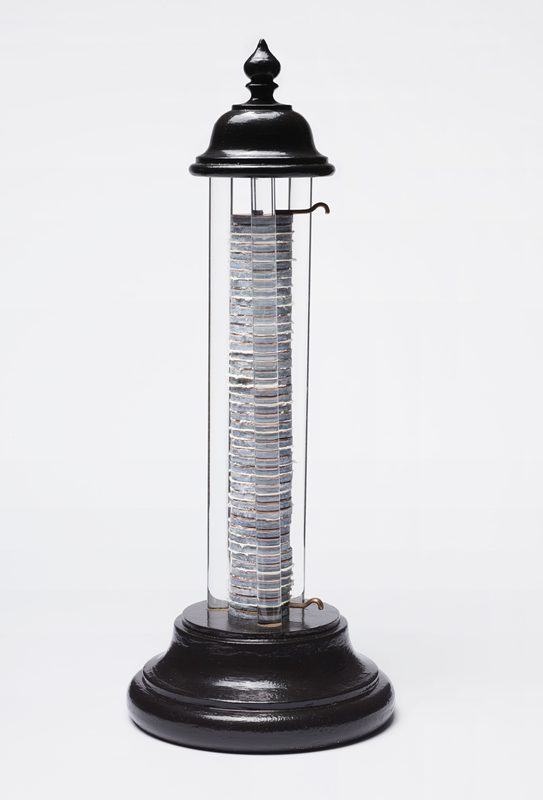
Image unavailable. The caption and source are still available.
The story
In a letter to Royal Society president Joseph Banks, Volta described a pile made from repeated metal-and-electrolyte units. It emerged from debates involving Galvani and others. Volta emphasized metallic contact, rather than providing today’s complete electrochemical explanation. Early piles also suffered polarization and other limitations: sustained operation did not mean an indefinitely constant current.
Connections and context
A usable current source supported electrolysis, Ørsted’s magnetic experiments and later circuit research, showing how new apparatus changes available questions.
Dates and precision
1800 (report of the pile) Documented date
Positioned by the documented year, month or day. Missing precision is not inferred.
Representative map location
Como
Como marks the location of Volta’s 1800 letter; he held a post in Pavia, and the Royal Society circulated the report from London.
Representative coordinates · 45.8081°, 9.0852°
A marker identifies one representative place, such as a manuscript collection, laboratory or observing site. It does not mean the work happened only there, or assign a shared discovery to one country.
Bibliography
- Alessandro Volta: On the electricity excited by the mere contact of conducting substances of different kinds (1800)
- Royal Society original letter chronology, Nature archive (1927)
References are listed as plain bibliography titles. They support particular facts or context; a reference does not certify every interpretation in a story.