
1801 (publication) / Europe
Disquisitiones arithmeticae organizes the theory of integers
Gauss connected congruences, quadratic forms and reciprocity in a systematic account of number theory.
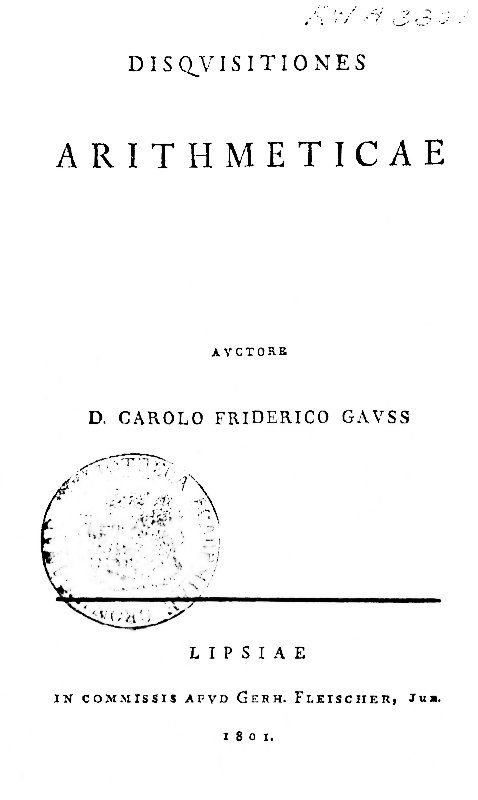
Image unavailable. The caption and source are still available.
The story
Published in 1801, Disquisitiones arithmeticae organized and extended work by Fermat, Euler, Lagrange, Legendre and others. Congruence notation made common-remainder relationships easier to manipulate; the book also linked cyclotomy with polygon construction. It gathered years of research rather than starting the study of integers from nothing, and Gauss’s later results should not all be read back into this volume.
Connections and context
Remainder arithmetic later became important in cryptography and computation; those applications were not already technologies described in the 1801 book.
Dates and precision
1801 (publication) Documented date
Positioned by the documented year, month or day. Missing precision is not inferred.
Representative map location
Brunswick
Brunswick represents Gauss’s early research setting; the first edition was issued by a Leipzig publisher.
Representative coordinates · 52.2689°, 10.5268°
A marker identifies one representative place, such as a manuscript collection, laboratory or observing site. It does not mean the work happened only there, or assign a shared discovery to one country.
Bibliography
- Smithsonian Libraries: Disquisitiones arithmeticae (1801)
- Library of Congress: Disquisitiones arithmeticae, first edition
- University of St Andrews: Gauss, Disquisitiones Arithmeticae
References are listed as plain bibliography titles. They support particular facts or context; a reference does not certify every interpretation in a story.