
1931 (incompleteness paper) / Europe
Gödel establishes limits to formal proof
Gödel showed limits to effectively axiomatized formal systems strong enough to express arithmetic.
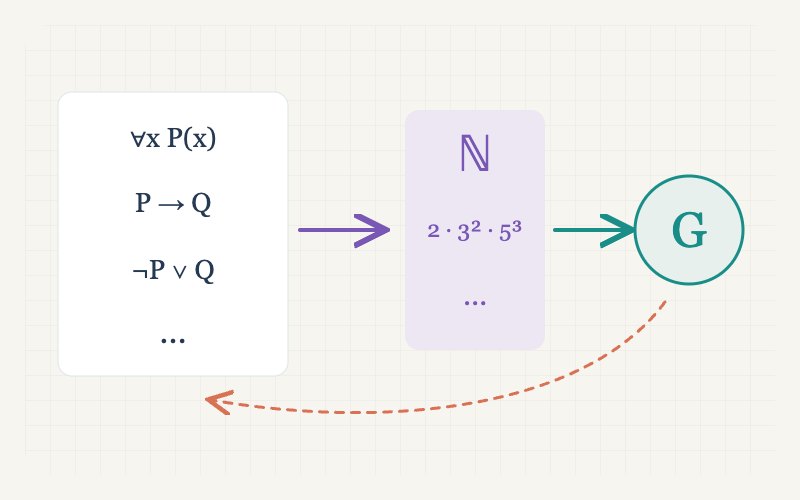
Image unavailable. The caption and source are still available.
The story
The 1931 paper established incompleteness results for formal systems with effectively specified axioms and sufficient arithmetic. Under suitable consistency conditions, some statements can neither be proved nor refuted within the system; systems meeting the relevant assumptions also cannot prove their own consistency internally. This does not make all mathematics unreliable or directly settle every question about human knowledge and machines.
Connections and context
Turing later approached decision problems through algorithms and computability. Incompleteness and uncomputability are connected, but they are different results.
Dates and precision
1931 (incompleteness paper) Documented date
Positioned by the documented year, month or day. Missing precision is not inferred.
Representative map location
Vienna
The marker identifies Gödel’s research setting when the paper appeared, not his later appointment in Princeton.
Representative coordinates · 48.2082°, 16.3738°
A marker identifies one representative place, such as a manuscript collection, laboratory or observing site. It does not mean the work happened only there, or assign a shared discovery to one country.
Bibliography
- Stanford Encyclopedia of Philosophy: Kurt Gödel
- Institute for Advanced Study: Kurt Gödel and the Institute
References are listed as plain bibliography titles. They support particular facts or context; a reference does not certify every interpretation in a story.