
1827 (circuit treatise published) / Europe
Ohm gives circuit experiments a mathematical form
Ohm connected current measurements with mathematical analysis of the relationships now expressed through voltage, current and resistance.
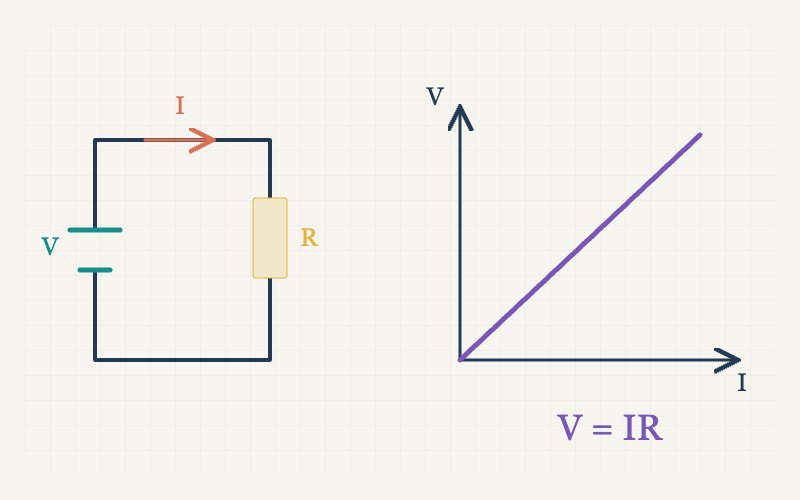
Image unavailable. The caption and source are still available.
The story
After experiments and papers in 1825–1826, Ohm published The Galvanic Circuit Investigated Mathematically in 1827. Improved measurements and a steadier thermoelectric source helped compare conducting wires. The modern expression V=IR describes ohmic behaviour under appropriate conditions, not every component without qualification. Present-day terminology and electrical units were not all established by this book.
Connections and context
From Volta’s pile and Ørsted’s magnetic effect to quantitative circuit relationships, measurement and calculation gradually became more closely connected.
Dates and precision
1827 (circuit treatise published) Documented date
Positioned by the documented year, month or day. Missing precision is not inferred.
Representative map location
Berlin
Berlin marks the book’s publication and preparation; Ohm’s earlier current experiments are associated with his teaching in Cologne.
Representative coordinates · 52.52°, 13.405°
A marker identifies one representative place, such as a manuscript collection, laboratory or observing site. It does not mean the work happened only there, or assign a shared discovery to one country.
Bibliography
- Science Museum Group: Georg Simon Ohm
- G. S. Ohm: The Galvanic Circuit Investigated Mathematically, original work in English translation
References are listed as plain bibliography titles. They support particular facts or context; a reference does not certify every interpretation in a story.