
1845 (early paddle-wheel report) / Europe
Joule compares mechanical work with heat
Falling weights drove paddles through liquid, allowing Joule to compare mechanical work with the resulting temperature rise.
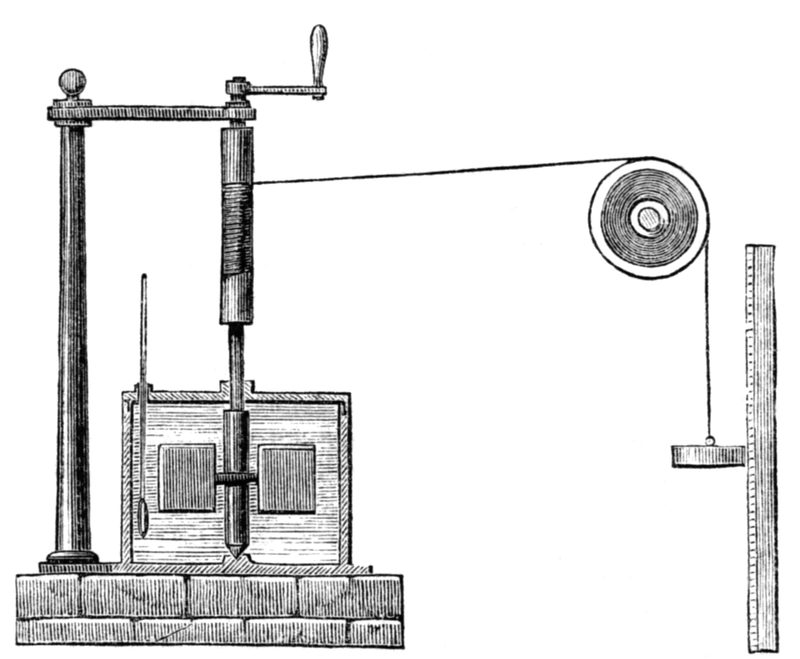
Image unavailable. The caption and source are still available.
The story
Joule investigated the mechanical equivalent of heat by several methods from 1843 onwards, reporting early paddle-wheel experiments in 1845. Later work improved thermometry, apparatus and error correction. His 1850 synthesis reviewed these experiments and gave more precise results. Mayer, Helmholtz and others followed different routes toward energy conservation; one experiment in 1845 did not establish the whole principle alone.
Connections and context
Electrical effects, motion and heating could be compared quantitatively, linking experimental precision with engineering and thermodynamics.
Dates and precision
1845 (early paddle-wheel report) Documented date
Positioned by the documented year, month or day. Missing precision is not inferred.
Representative map location
Salford
The point represents Joule’s long-term home and experimental region, not the venue of his 1845 presentation.
Representative coordinates · 53.4875°, -2.2901°
A marker identifies one representative place, such as a manuscript collection, laboratory or observing site. It does not mean the work happened only there, or assign a shared discovery to one country.
Bibliography
- James Prescott Joule: On the Mechanical Equivalent of Heat (1850), retrospective account of the 1845 experiments
- American Physical Society: Joule and the mechanical equivalent of heat
References are listed as plain bibliography titles. They support particular facts or context; a reference does not certify every interpretation in a story.