
18 January 1871 · imperial proclamation / Europe
The German Empire is proclaimed at Versailles
Nationalism and dynastic power converged in a Prussian-led empire that excluded Austria; national unification did not establish equal political power for everyone.
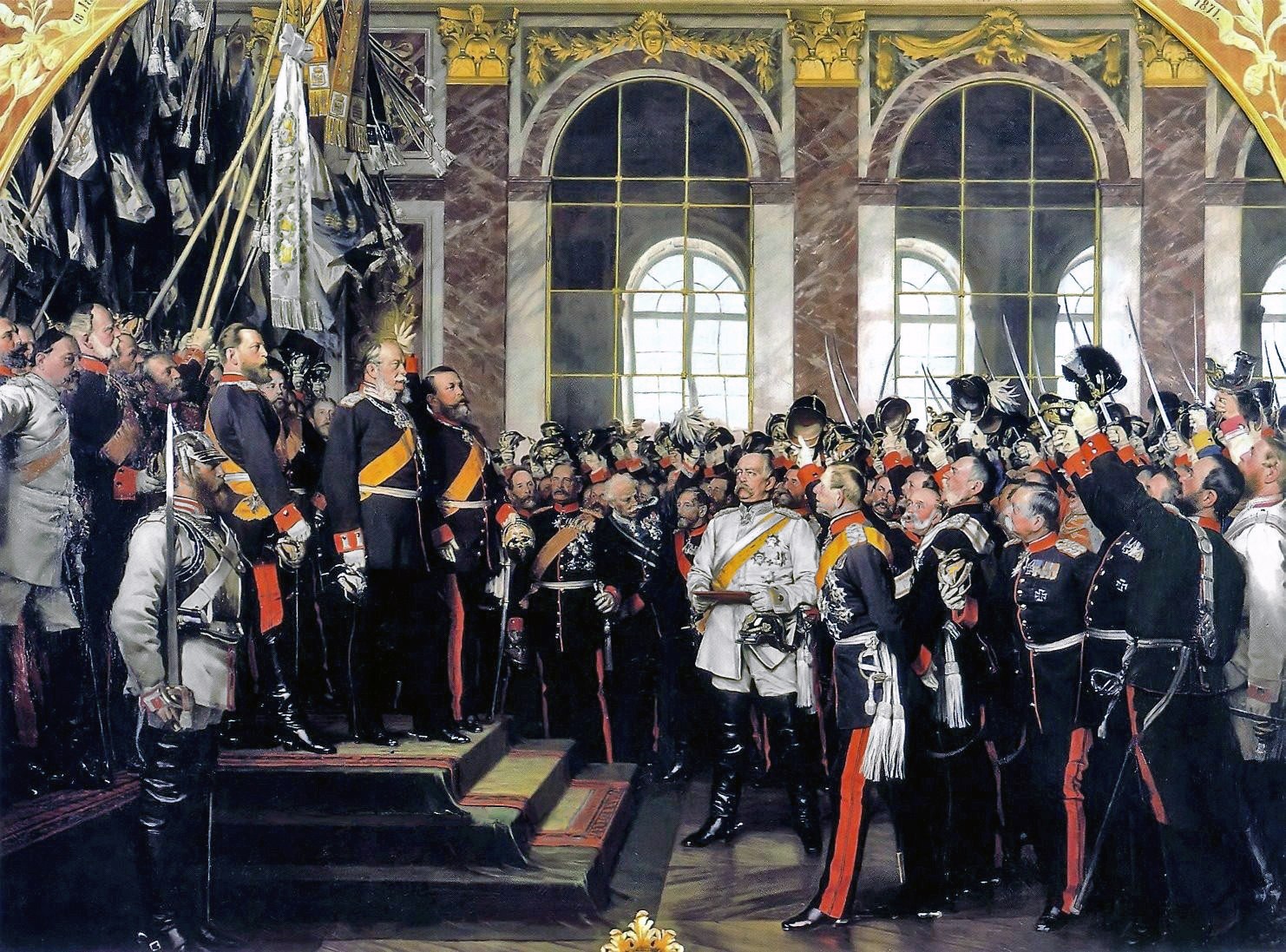
Image unavailable. The caption and source are still available.
The story
On 18 January 1871, during the Franco-Prussian War, Prussia’s King Wilhelm I was proclaimed German Emperor in the Hall of Mirrors at Versailles. This ceremony symbolically marked imperial unification; the constitutional arrangements bringing the southern German states into the federation had already taken effect on 1 January. The proclamation was one stage in a process shaped by treaties, parliamentary decisions and war.
The outcome followed a Prussian-led solution that excluded Austria. A shared German language did not produce a state containing every German-speaking community, nor a population with one political outlook. Princes and governments retained important powers within a federal monarchy. The Reichstag gave adult male voters a national electoral arena, but women had no vote, and the chancellor answered to the emperor rather than to parliamentary confidence.
Nationalism helped connect demands for unity with a powerful new state, while the settlement also drew boundaries around belonging and participation. Polish-, Danish- and French-speaking inhabitants lived within the empire, with differing attachments and interests. The ceremony therefore opens questions about who defined the nation and who exercised authority; it does not show that unification automatically brought democracy or agreement.
Elsewhere in the world
Compare the national and constitutional demands of 1848 with the dynastic settlement of 1871: a common demand for unity could lead to very different distributions of political power.
Dates and precision
18 January 1871 · imperial proclamation Documented date
Positioned by the documented year, month or day; missing months and days are not inferred.
Representative map location
Versailles
The marker identifies the proclamation at Versailles, in present-day France; it does not indicate the empire’s capital or territorial extent.
Representative coordinates · 48.8049°, 2.1204°
Coordinates locate a representative point for the story. They do not mean the event happened only here and do not represent historical borders.
Bibliography
- German Historical Museum | The German Empire (German original)
- German Bundestag | The first Reichstag and imperial unification (German original)
Sources are listed as bibliography titles, without external links. A reference does not mean every sentence or interpretation has been independently verified.