
24 April 1916 · rising begins / Europe
The Easter Rising challenges British rule in Ireland
Republican insurgents proclaimed an Irish republic during the First World War, linking nationalism to armed resistance; their aims and methods were not shared by everyone in Ireland.
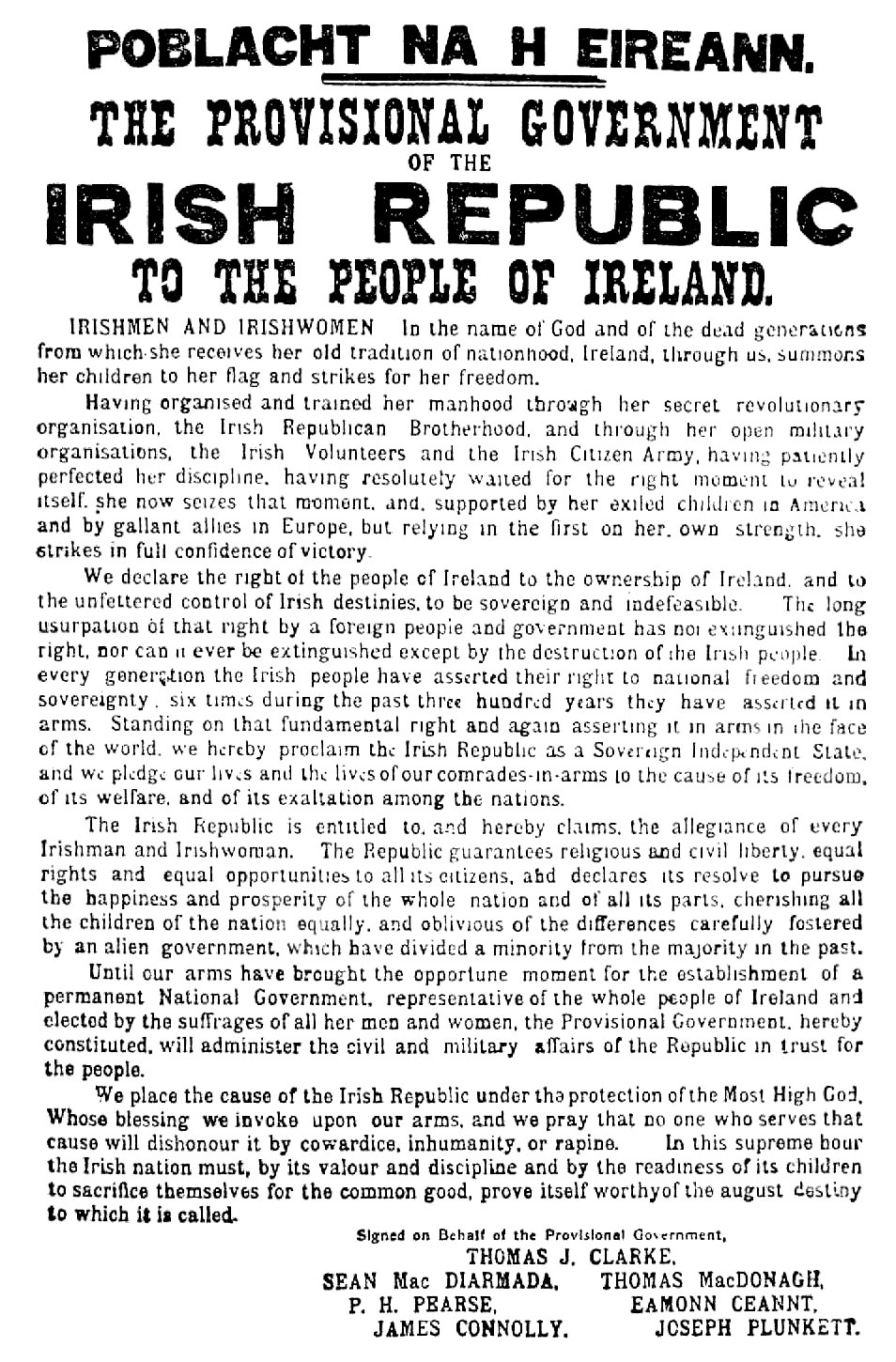
Image unavailable. The caption and source are still available.
The story
On Easter Monday, 24 April 1916, insurgents occupied positions in Dublin, including the General Post Office, where Patrick Pearse proclaimed an Irish republic. The action challenged British rule while Britain was fighting the First World War. The date marks the beginning of the rising, not the establishment of an independent state with effective control over Ireland.
Irish political life contained competing projects. Republicans sought separation, constitutional nationalists pursued Home Rule through Parliament, and unionists defended the connection with Britain. These positions were themselves diverse. The rising cannot be treated as proof of unanimous public support for armed revolt or a single national will. British forces suppressed it within a week; fighting killed civilians as well as combatants and damaged central Dublin.
Executions and repression after the surrender helped change political attitudes and gave the rising a lasting place in independence movements and public memory. That later importance should not erase contemporary disagreement or the human cost. The 1921 Anglo-Irish Treaty and the creation of the Irish Free State in 1922 belonged to a later process; six northern counties remained within the United Kingdom.
Elsewhere in the world
Place the rising beside the First World War and later decolonization: national self-government, parliamentary reform and armed action were competing strategies, not interchangeable steps on a predetermined path.
Dates and precision
24 April 1916 · rising begins Documented date
Positioned by the documented year, month or day; missing months and days are not inferred.
Representative map location
Dublin · General Post Office
The marker identifies the General Post Office in Dublin, a headquarters of the rising; activity also occurred elsewhere in Ireland.
Representative coordinates · 53.3493°, -6.2603°
Coordinates locate a representative point for the story. They do not mean the event happened only here and do not represent historical borders.
Bibliography
- National Library of Ireland | Easter Monday, 24 April
- National Library of Ireland | John Redmond and the Irish Parliamentary Party
- National Library of Ireland | Carson and the Ulster unionists
- National Library of Ireland | Aftermath of the Rising
Sources are listed as bibliography titles, without external links. A reference does not mean every sentence or interpretation has been independently verified.