
1854 (Laws of Thought published) / Europe
Boole brings algebra to logic and probability
Boole expressed classes and logical relations through symbolic operations, providing mathematical tools later adapted to switching circuits and computing.
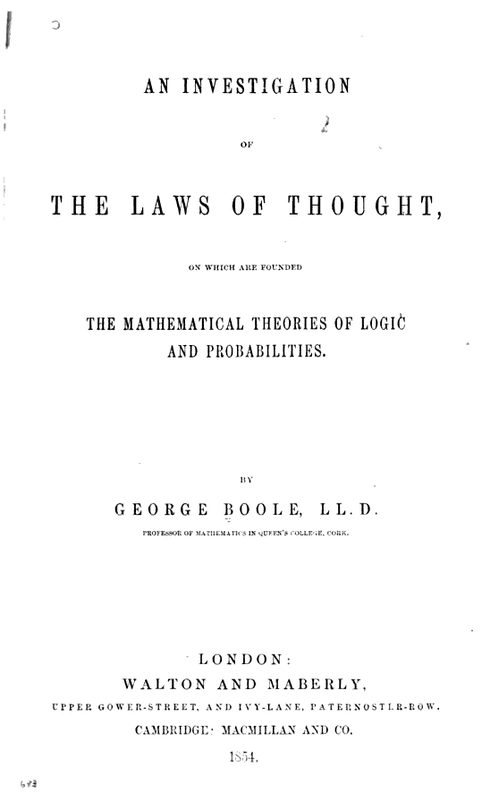
Image unavailable. The caption and source are still available.
The story
While teaching in Cork, Boole published An Investigation of the Laws of Thought, extending his earlier algebraic approach to logic and discussing probability. This was a study of reasoning, not a design for an electronic computer. Later mathematicians reformulated Boolean algebra, and Shannon applied related logic to switching circuits in the twentieth century. Those subsequent developments should not all be assigned to 1854.
Connections and context
The journey from logical expressions to circuits shows how abstract mathematics can acquire new engineering uses. Boole’s work, Turing’s computation model and Shannon’s information theory address different questions.
Dates and precision
1854 (Laws of Thought published) Documented date
Positioned by the documented year, month or day. Missing precision is not inferred.
Representative map location
Cork
The marker represents Boole’s teaching and writing in Cork. The 1854 book was published in London.
Representative coordinates · 51.8985°, -8.4756°
A marker identifies one representative place, such as a manuscript collection, laboratory or observing site. It does not mean the work happened only there, or assign a shared discovery to one country.
Bibliography
- University College Cork: Professor George Boole
- Stanford Encyclopedia of Philosophy: George Boole
References are listed as plain bibliography titles. They support particular facts or context; a reference does not certify every interpretation in a story.