
24 February 1848 (Paris turning point) / Europe
Paris’s February Revolution and Europe’s revolutionary wave
Louis-Philippe’s fall in Paris accelerated a European wave of uprisings. Demands for constitutions, national unity and social reform overlapped, but did not form one common programme.
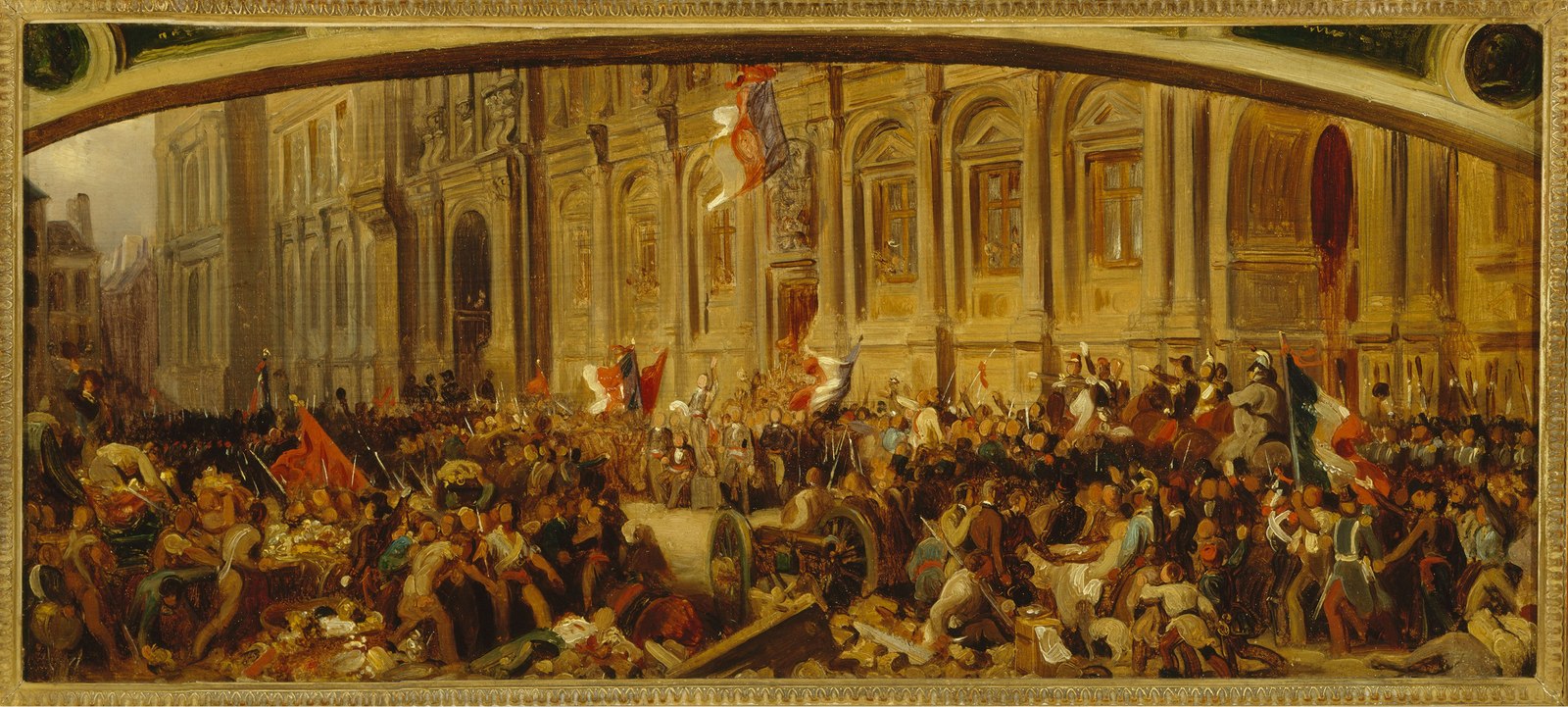
Image unavailable. The caption and source are still available.
The story
On 24 February 1848, after demonstrations and street fighting in Paris, King Louis-Philippe abdicated. A provisional government replaced the July Monarchy. Economic hardship, unemployment and restricted political representation had brought together opponents whose expectations of a republic were far from identical.
Paris was an influential turning point, not the starting date of every European revolution: revolt had already begun in Sicily in January. Across the German states, the Italian states and the Habsburg lands, movements combined demands for constitutions, civil liberties, national unity or independence in different ways. Workers’ demands concerning employment and living conditions could conflict with liberal priorities; national movements also had competing claims.
In France, the widening of male suffrage did not include women. Arguments over the republic’s social responsibilities sharpened, and the June workers’ uprising was violently suppressed. By 1849 many revolutionary governments and assemblies had been defeated, including the attempt to establish a constitutional German nation-state through the Frankfurt parliament. Historians weigh these immediate defeats against the longer influence of constitutional proposals, political organisation and debates about citizenship; neither a single victory nor a wholly unchanged Europe captures the outcome.
Elsewhere in the world
Compare the rights debate of the French Revolution with the social and municipal demands raised again in the Paris Commune of 1871. These connections show recurring questions, not one uninterrupted revolutionary movement.
Dates and precision
24 February 1848 (Paris turning point) Documented date
Positioned by the documented year, month or day; missing months and days are not inferred.
Representative map location
Paris · February 1848
The point marks Paris as a representative turning point. The 1848–1849 revolutions involved many places across Europe; this marker does not show a common territory or a single starting date.
Representative coordinates · 48.8566°, 2.3522°
Coordinates locate a representative point for the story. They do not mean the event happened only here and do not represent historical borders.
Bibliography
- Assemblée nationale | Révolution de février
- Deutscher Bundestag | Revolution und Frankfurter Nationalversammlung 1848/1849
- Assemblée nationale | Gouvernement provisoire et proclamation de la Deuxième République
- Assemblée nationale | La conquête de la citoyenneté politique des femmes
- Bundeszentrale für politische Bildung | Die Revolutionen von 1848/49
- Presidenza della Repubblica Italiana | Palermo: Medaglia alle Città Benemerite del Risorgimento Nazionale
Sources are listed as bibliography titles, without external links. A reference does not mean every sentence or interpretation has been independently verified.